Following the release of its EASO Guidance on reception conditions: operational standards and indicators in December 2016, EASO has just issued the EASO guidance on contingency planning in the context of reception.
Other government information and services: belgium.be
The GRETA report, covering the period from 1 January until 31 December 2018, stresses that labour exploitation is on the rise across Europe. Also in Belgium, labour exploitation appears as a predominant form of trafficking.
Two United Nations agencies are joining forces to combat migrant smuggling. They organized an event centering on a Joint Platform on Countering Migrant Smuggling.
Om meer aandacht te krijgen voor illegale tewerkstelling van derdelanders in België en de EU en voor de EMN studies hierover, maakte het Belgisch Contactpunt van het EMN een korte video.
Following the adoption of the Cooperation Agreement on the Single Permit Procedure on 2 February 2018, different legislative texts have been adopted at the federal and regional levels in March 2018 to approve this Cooperation Agreement.
De regering keurde op 24 maart 2018 een nieuw afbouwplan van opvangplaatsen voor verzoekers om internationale bescherming goed. Vandaag bestaat het opvangnetwerk uit 23.815 opvangplaatsen. Dat moet in 2019 terug gebracht zijn tot 16.629 opvangplaatsen, waarvan 10.044 collectieve plaatsen en 6.585 individuele opvangplaatsen. Met dit plan keert het netwerk terug naar het normale niveau van vóór de opvangcrisis.
In Februari, Fedasil, het federaal agentschap voor de opvang van asielzoekers heeft een samenwerkingsakkord met Enabel (www.enabel.be), het Belgisch ontwikkelingsagentschap (voorheen de Belgische technische Coöperatie) getekend.
Vrijwillige terugkeer naar de landen van herkomst neemt af. De oorzaak hiervoor is het lager aantal asielaanvragen van de afgelopen twee jaar.
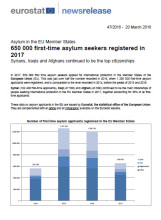
Today Eurostat published the 2017 statistics on 'Asylum in the EU' on its website. It covers main trends and characteristics of first time applicants and first instance decisions on asylum applications for 2017 in the EU.
At the height of the refugee “crisis” in October 2015, over 7,000 asylum seekers crossed the Aegean Sea from Turkey to Greece per day. This created problematic conditions for refugees in reception centers and overwhelmed Greece as a first country of entry to the EU. In this setting, the EU-Turkey Statement was concluded with the aim of managing migration across the Aegean Sea and curbing arrivals to the EU. Whilst the Statement was effective in reducing the number of arrivals, it has been met with a series of human rights concerns.
This training session (in Dutch) provided by the Flemish Agency for Integration and Civic Integration aims at providing participants with a basic understanding of international family law.
The European Commission proposes to reform the EU's common visa policy. It also reports on - and calls for - further progress under the European Agenda on Migration. Finally it mobilises additional funding for Syrian refugees in Turkey.
These 2 training sessions (in Dutch) provided by the Flemish Agency for Integration and Civic Integration aim at providing participants with a basic understanding of the different residence statuses in Belgium, the different residence documents, and - to some extent - the associated rights.
These 2 training sessions (in Dutch) provided by the Flemish Agency for Integration and Civic Integration aim at providing participants with a basic understanding of the different residence statuses in Belgium, the different residence documents, and - to some extent - the associated rights.
Today, March 12, 2018 the Law of 21 November 2017 (adopted in the Parliament on Nov. 9) modifying the Immigration Act was published in the Belgian Official Gazette and will come into force on March 22, 2018.
This training session (in Dutch) provided by the Flemish Agency for Integration and Civic Integration aims at providing participants with a basic understanding of international family law.
Deze EMN Inform geeft een overzicht van het beleid en praktijken van (lid)staten met betrekking tot veilige landen van herkomst. Het beschrijft welke landen een lijst met veilige landen van herkomst hebben ingevoerd en of onderdanen van deze landen anders worden behandeld dan onderdanen van andere landen in de procedure voor internationale bescherming. Bovendien worden verschillen met betrekking tot opvangvoorzieningen en terugkeerbepalingen onderzocht.
Today, the Belgian Minister of Home Affairs, the Belgian State Secretary for Asylum Policy and Migration met with the British Home Secretary in London to discuss the issue of transit migration.
This EMN Inform summarizes the main findings of the EMN study “The effectiveness of return in EU Member States: challenges and good practices linked to EU rules and standards”.
From 21 until 23 February 2018, the Belgian State Secretary for Asylum Policy and Migration, Theo Francken, visited Guinea in order to discuss the questions of – inter alia - irregular migration and return.
Today, Frontex published its Risk Analysis for 2018, which concentrates on the scope of Frontex operational activities and, in particular, on irregular migration at the external borders of the EU and Schengen Associated Countries.
On 22 December 2017, Deputy Prime Minister Jan Jambon, in the name of the government, asked the Office of the Commissioner General for Refugees and Stateless Persons (CGRS) to carry out an independent inquiry regarding the risk in case of return to Sudan. The report was handed over to the government on 8 February 2018.
This training session (in Dutch) provided by the Flemish Agency for Integration and Civic Integration aims at providing participants with a basic understanding of international family law.
This portal allows any user – whether analyst, scientist, policymaker or interested citizen – to discover a wealth of migration information including data sources, relevant websites, stakeholder organisations, projects, networks and forums related to migration flows, trends and their impact on societies across the EU.
This updated report assesses how the presence of persons in need of protection affect the local communities in terms of housing, education, local economy and social responses