
This conference will explore European and Dutch experiences in supporting the early integration of applicants for international protection, with a particular focus on employment, language learning and cultural orientation. Drawing on the findings of a new EMN Inform, the event will bring together policymakers, experts and practitioners to discuss different national approaches, implementation challenges and good practices across Europe.

08/07/2026
The Belgian Council of State has suspended the decision of the Minister of Asylum and Migration to limit material reception conditions for applicants for international protection who have already obtained protection in another EU Member State. In its judgment No. 267.364 of 8 July 2026, the Council of State suspended the measure following an urgent appeal introduced by several organisations active in the field of asylum and migration. The decision concerns a measure adopted following the entry into application of the European Pact on Migration and Asylum on 12 June 2026.
04/06/2026
This Inform, covering developments across 22 EMN Member Countries, as well as Norway and Serbia, explores the use of alternatives to providing in-kind housing for applicants for international protection between January 2020 and October 2025. It examines how such measures were implemented while respecting legal obligations and supporting applicants’ autonomy, addressing their vulnerability, and promoting their integration into society. The Inform focuses on financial allowances and vouchers as alternatives to accommodation provided directly by the state and highlights national approaches and innovative solutions identified across participating countries.
Theme:
Publication type:
Keywords:
27/05/2026
This ad hoc query examines whether EMN Member and Observer Countries experience irregular occupancy within their reception systems. It explores whether countries have mechanisms that allow individuals in the reception system to save part of their income to facilitate access to independent housing, or whether direct financial support is provided. The query also considers whether countries have mechanisms for individuals who unjustifiably refuse to leave the reception system, as well as any financial reimbursement mechanisms for costs incurred when an individual remains irregularly.
Theme:
Publication type:
Keywords:
15/05/2026
This ad hoc query examines the ways in which EMN Member and Observer Countries calculate periods of absence in the context of applications for an EU Long-Term Residence Status, which requires 5 years of continuous residence. Additionally, this ad hoc query inquires about the use of Artificial Intelligence (AI) or Optical Character Recognition (OCR) in EMN Member and Observer Countries, or any future plans to do so.
Theme:
Publication type:
Keywords:

13/05/2026
The Belgian Council of Ministers has approved a draft bill aimed at strengthening rules on labour migration and improving the framework for highly qualified non-EU workers. The proposal includes measures aimed at strengthening the fight against fraud linked to labour migration, while also seeking to make the European Blue Card more attractive for highly qualified workers from outside the European Union. The draft bill also provides for additional protection for workers who are victims of certain social law infringements committed by employers. The text will now be submitted to the Council of State for advice.
Theme:
Type:
Keywords:
12/05/2026
This Inform examines how digital services in legal migration procedures are designed and implemented in EMN Member and Observer Countries to ensure accessibility and inclusion for applicants with disabilities and digitally disadvantaged applicants. It looks at how authorities have adapted applications, document submission, appointment booking, communication and information exchange, and case-tracking services in the context of the ongoing digitalisation of legal migration procedures. The analysis is based on contributions from 25 EMN Member and Observer Countries.
Theme:
Publication type:
Keywords:

07/05/2026
The Court of Justice of the European Union has ruled on the compatibility of a national residence requirement with EU equal treatment rules. The Court examined whether a 10-year residence condition could be applied to beneficiaries of international protection in order to access a social benefit. It found that the measure constitutes indirect discrimination prohibited under EU law.

07/05/2026
DUO for a JOB has launched a national awareness campaign highlighting the persistence of discrimination in recruitment processes in Belgium. The initiative uses the format of the well-known game “Guess Who?” to illustrate how candidates may still be excluded on the basis of appearance, name, origin or accent rather than skills. The campaign is being rolled out in May across public spaces, including stations and metro networks in several Belgian cities.
06/05/2026
This ad hoc query examines whether, and how, EMN Member and Observer Countries regulate employment agencies that charge recruitment fees to third-country national workers. More specifically, it gathers information on the legislative basis for such regulations as well as set maximum fees and sanctions in cases where recruitment fees were charged unlawfully to third-country workers.
Theme:
Publication type:
Keywords:
06/05/2026
This ad hoc query maps the legislation and administrative practices of EMN Member and Observer Countries regarding the issuance of temporary residence permits to third-country nationals based on the purchase or long-term rental of real estate. It explores the specific conditions for these permits and identifies any issues or particularities encountered by national authorities in their issuance.
Theme:
Publication type:
Keywords:
30/04/2026
This ad hoc query examines whether EMN Member and Observer Countries implement measures to facilitate a more efficient and effective recognition of the qualifications of third-country nationals (TCNs) for access to regulated professions. It explores whether countries use specific assessment methods to enable TCNs to enter regulated professions, whether they facilitate or accelerate the recognition procedure for specific groups of TCNs or specific professions, and whether they have institutional arrangements or coordination mechanisms in place to facilitate that recognition. The query also considers whether countries are involved in cooperation activities related to these recognition procedures.
Theme:
Publication type:
Keywords:
30/04/2026
This ad hoc query examines whether EMN Member Countries allow persons holding a Schengen visa and persons enjoying visa-free travel to apply for a single permit on their territory during their short stay. Additionally, the ad hoc query inquires about different aspects of such procedures as well as possibilities for third-country nationals to obtain a visa for the purpose of seeking employment.
Theme:
Publication type:
Keywords:
10/04/2026
This ad hoc query examines the extent to which EMN Member and Observer Countries require medical certificates in the context of applications for temporary and permanent residence permits. More specifically, it inquires at what stage in the procedure the medical certificate is requested and what medical conditions are examined.
Theme:
Publication type:
Keywords:

09/04/2026
On 9 April 2026, the European Court of Human Rights delivered its judgment in M.V. and Others v. Belgium and held that Belgium had violated several provisions of the European Convention on Human Rights in relation to the reception conditions of four applicants for international protection.
28/03/2026
The Fedasil Pondrôme reception centre will host a photo exhibition featuring the work of unaccompanied and accompanied minors. The images were created over an eighteen-month project led by CIDJ Rochefort–Beauraing. The exhibition provides insight into the daily lives, experiences, and identities of the young participants. The event is free, open to all, and offers an opportunity to meet the creators.
05/04/2026
This ad hoc query examines requirements relating to residence and work permits for seafarers, as well as pilots of aircraft and other crew personnel. It enquires about the specificities of such requirements and assesses to what extent different rules apply to vessels registered in EU/EEA countries as opposed to vessels registered in third countries.
Theme:
Publication type:
Keywords:

27/03/2026
The Belgian Council of State has suspended a ministerial instruction that systematically limited material assistance to international protection applicants who had already obtained protection in another EU Member State. The court ruled that the instruction exposed these individuals to the risk of severe hardship and potential homelessness. It also noted that, due to its regulatory character, the instruction should have been submitted for review by the Council of State’s Legislation Section.
Theme:
Type:
Keywords:

20/03/2026
On 20 March 2026, the Belgian Council of Ministers approved a draft law that would link the level of social assistance granted to beneficiaries of subsidiary and temporary protection to their participation in integration efforts through the Individual Social Integration Project (ISIP). Under the proposal, the amount of social assistance could be adjusted depending on the efforts made by the beneficiary to integrate.

20/03/2026
Belgium plans to progressively return several defence sites used for the reception of applicants for international protection to military use as part of a broader plan to expand defence infrastructure towards 2040. The measure concerns around 4.000 reception places located on military premises across the country. Authorities state that the reduction in capacity can be absorbed within the existing reception network. The transition will take place gradually, with closures scheduled at different times depending on the site.
19/03/2026
This ad hoc query inquires about the differences in access to social assistance benefits for refugees, beneficiaries of subsidiary protection and beneficiaries of temporary protection in EMN Member Countries. Additionally, it looks at the reasons given for these differences in access to social assistance benefits and considers whether there are any plans or proposals to introduce further distinctions in access for these groups in the near future.
Theme:
Publication type:
Keywords:

18/03/2026
The Netherlands has decided to resume Dublin transfers of single, non-vulnerable male asylum seekers to Belgium, following a period in which such transfers were suspended after a Dutch court ruling. In April 2025, the District Court of The Hague, sitting in Groningen, found that single male asylum seekers risked being deprived of adequate reception conditions in Belgium, which could expose them to inhumane or degrading treatment. The ruling led to a halt in transfers under the EU Dublin system.
Theme:
Type:
Keywords:
13/03/2026
Myria, the Federal Migration Centre, has advised against a draft law proposing to remove the legal possibility of activating a mandatory distribution plan for reception places in times of crisis. The plan allows the federal government to require municipalities to provide local reception initiatives according to objective allocation criteria. Myria stresses that this mechanism is important to safeguard human dignity and the right to reception, particularly during periods of structural shortages.
13/03/2026
CIRÉ, together with partner organisations, has lodged an urgent appeal at the Council of State challenging a ministerial instruction that continues to exclude asylum seekers who have already been granted protection in another EU member state from reception facilities. The move follows a recent temporary suspension of the measure by the Constitutional Court. CIRÉ argues the instruction undermines judicial authority and the rule of law.
Theme:
Type:
Keywords:
12/03/2026
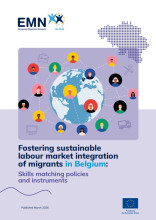
This study examines skills matching for migrants in Belgium as part of a broader European-level analysis conducted within the framework of the EMN. It focuses on how policies and initiatives align migrants’ qualifications and skills with labour market needs. The analysis considers both vertical and horizontal mismatches, where skills or fields of study do not correspond to job requirements. It identifies key challenges, as well as lessons learned and good practices, in supporting sustainable labour market integration through improved skills matching.