Publication date:
On 21 and 22 May 2025, the European Migration Network’s Return Experts Group (EMN REG) convened a two-day workshop, hosted by the Belgian Immigration Office and EMN Belgium. The event brought together 50 participants from EU Member States, EU agencies (including Frontex and the EU Asylum Agency), civil society organisations, and international organisations. The workshop focused on the development and implementation of effective alternatives to detention (ATDs) within the EU’s migration and return systems.
Read more
Publication date:
The European Commission has released new figures revealing a substantial rise in short-stay visa applications to the EU and Schengen-associated countries in 2024. With over 11.7 million applications submitted, the upward trend reflects a continued post-pandemic recovery, although numbers remain below pre-COVID levels. Notably, Bulgaria and Romania began issuing Schengen visas on 31 March 2024, further integrating into the Schengen visa system.
Read more
Main theme: Borders & Visa
Keywords: short stay, visa application, Schengen visa
Publication date:
On 20 May 2025, the European Commission put forward a proposal to revise the rules governing the application of the safe third country concept. The proposal, which inter alia removes the requirement to establish a connection between the applicant and the safe third country, is now subject to approval by the European Parliament and the Council. It has prompted a range of reactions, including expressions of support as well as more critical assessments.
Read more
Publication date:
On 17 May, the International Day Against Homophobia, Biphobia and Transphobia (IDAHOBIT), the organisation Prisme has disclosed a set of recommendations highlighting the challenges faced by LGBTQIA+ individuals seeking international protection in Belgium. These findings point to several shortcomings in the reception and asylum system and outline measures to ensure more inclusive procedures.
Read more
Main theme: Vulnerable groups, Reception, International Protection
Keywords: LGBTQIA+, applicant for international protection, reception centre, special needs, Training, inclusion

Publication date:
On 13 May 2025, Belgian authorities arrested six individuals in West Flanders as part of a coordinated international operation targeting an organised migrant smuggling network suspected of facilitating the irregular entry of up to 300 non-EU nationals into the European Union. In total, fifteen suspects were apprehended in Belgium, Germany and Poland, in a series of actions supported by Europol and Eurojust and involving close cooperation between law enforcement and judicial authorities in the participating countries.
Read more
Main theme: Smuggling & Trafficking
Keywords: migrant smuggling, smuggling network, joint action day, Europol, Eurojust
Publication date:
According to Statbel, the Belgian statistical office, 4.922 persons obtained Belgian nationality in February 2025. The main countries of origin of people who acquired Belgian nationality in February are Morocco, Romania, Syria, Turkey and Afghanistan.
Read more
Main theme: Citizenship & Nationality
Keywords: access to nationality, Belgian nationality
Publication date:
According to preliminary data published by Frontex, the number of irregular border crossings into the European Union decreased by 27% between January and April 2025, compared to the same period in 2024. Nearly 47.000 crossings were detected during the first four months of 2025.
Read more

Publication date:
On 11-12 May 2025, Belgian Minister for Asylum and Migration Anneleen Van Bossuyt visited Chisinau to emphasise that asylum applications from Moldovan nationals—coming from a country considered safe—are processed through an accelerated procedure in Belgium. She also announced the immediate discontinuation of the return incentive, which is seen as encouraging misuse of the asylum system.
Read more
Main theme: International Protection, Irregular Migration
Keywords: unfounded asylum application, moldova, safe country of origin, return incentive
Publication date:
The European Commission has approved an additional €3 billion in funding to assist Member States in implementing the Pact on Migration and Asylum and to support the hosting of beneficiaries of temporary protection from Ukraine. This amount is composed of €1.8 billion from the revision of the current Multiannual Financial Framework and a €1.2 billion top-up to the Asylum Migration and Integration Fund (AMIF) and the Border Management and Visa Instrument (BMVI).
Read more
Publication date:
In 2024, 19.435 people participated in the Social Orientation (Maatschappelijke Oriëntatie, MO) course in Flanders. This marks a significant increase in participation. Alongside the rising numbers of participants in the Social Orientation course, the demand for Dutch as a Second Language (NT2) courses also remains high, as evidenced by recent reports from AMAL vzw, Atlas Antwerp, and the Agency for Integration and Civic Integration.
Read more
Main theme: Integration
Keywords: civic integration course, Agency for Integration and Civic Integration, language learning, language course

Publication date:
On 7 May 2025, the Court of First Instance of West Flanders, Bruges division, sentenced the Vietnamese national, N. Van Kim (34), in absentia to twelve years’ imprisonment and a fine of €616,000 for human smuggling under aggravating circumstances. The court also ordered the deprivation of his civil rights for ten years and issued a warrant for his immediate arrest.
Read more
Main theme: Smuggling & Trafficking
Keywords: Essex lorry tragedy, Bruges criminal court, Vietnamese migrants, smuggling network, migrant death
Publication date:
On the occasion of Labour Day, Fedasil published new figures on the professional activity of applicants for international protection residing in reception centres. In 2024, 41% of those allowed to work were active on the Belgian labour market. The data show differences in employment rates depending on gender, age, and nationality.
Read more
Main theme: Integration
Keywords: applicant for international protection, access to employment, labour market access
Publication date:
Myria, the Federal Migration Centre, warns that the measures announced by the federal government in its "Easter Agreement" violate the right to family life. The institution announced in a press release published on Tuesday that it had shared its observations with the government and expressed hope for a constructive dialogue.
Read more

Publication date:
On 28 April 2025, Samusocial launched a new shelter dedicated to unaccompanied foreign minors living on the streets, often referred to as “wandering” minors. This centre aims to provide a safe and supportive space for young people with complex needs who do not have access to existing aid structures.
Read more
Main theme: Vulnerable groups
Keywords: unaccompanied foreign minor, mental health, risk of exploitation, shelter
Publication date:
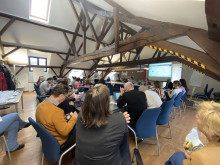
During a lunch & learn session, the EMN Belgium team met with around 30 Fedasil staff members to present the work of the European Migration Network, encourage active participation in the national network, and provide updates on recent and upcoming publications and activities.
Read more
Main theme: Reception

Publication date:
On 23 April 2025, the Office of the Commissioner General for Refugees and Stateless Persons (CGRS) announced an extension of the suspension of the processing of applications for international protection from Syrian nationals. The suspension, initially introduced on 9 December 2024, will remain in place until at least the end of July 2025.
Read more
Main theme: International Protection
Keywords: application for international protection, Syria

Publication date:
EMN Luxembourg, in cooperation with the Ombudsman for Children and Adolescents in Luxembourg and the European Network of Ombudsmen for Children, organise a joint capacity-building event to support Member States and their respective institutions in implementing the Pact, especially regarding children’s rights.
Read more
Main theme: Vulnerable groups
Keywords: New Pact on Migration and Asylum, children's right, child, guardianship

Publication date:
This event aims to help migration policymakers and practitioners better understand the potential of AI applications as well as the regulatory framework of the AI Act and its impact on the use of AI in migration management, and to discuss the impact of AI on policymaking.
Read more
Main theme: Cross-sectional
Keywords: migration policy, migration management, artificial intelligence, digitalisation, Artificial Intelligence Act

Publication date:
This conference will explore the role labour migration might play in addressing labour market shortages in the Netherlands and the broader European context, while considering both the benefits and the challenges it brings. Participants will look at case studies and delve into concrete examples from other EU Member States, and explore various approaches to managing labour migration. Policymakers and experts will engage in this dialogue to examine the diverse policy choices that might shape the future of labour migration policies.
Read more
Main theme: Economic migration
Keywords: labour migration, labour migration policy, labour shortage
Publication date:
This data comes from Bruss’help’s eighth count, carried out through a large-scale collaboration across sectors and indicating a worsening trend of homelessness in Brussels. For the first time, data from reception centres for applicants for international protection were collected. Out of 5.135 individuals, 17 were required to leave their centre within 30 days without any housing solution, while 94 remained beyond their expected departure due to the lack of stable housing options.
Read more
Main theme: Vulnerable groups
Keywords: homelessness, homeless, housing shortage, emergency shelter
Publication date:
The European Commission has issued a proposal to accelerate the implementation of certain aspects of the Pact on Migration and Asylum, with the aim of helping Member States process asylum claims more quickly, particularly for applicants whose claims are likely to be unfounded. In addition, the proposal includes the establishment of an EU-wide list of safe countries of origin. Human rights organisations have raised concerns, especially about the inclusion of Egypt, Tunisia, and Morocco, which they argue have ongoing human rights issues.
Read more

Publication date:
Recent data requested by Green party MP Matti Vandemaele from the Minister for Asylum and Migration, Anneleen Van Bossuyt (N-VA), indicate a notable increase in the time taken to process applications for international protection. This trend has implications for applicants, who remain in prolonged uncertainty, and for the national reception system, which continues to face significant pressure.
Read more
Main theme: International Protection
Keywords: application for international protection, processing time, backlog, reception centre
Publication date:
According to Statbel, the Belgian statistical office, 5.353 persons obtained Belgian nationality in January 2025. The main countries of origin of people who acquired Belgian nationality in January are Morocco, Romania, Syria, Italy and Turkey.
Read more
Main theme: Citizenship & Nationality
Keywords: Belgian nationality, access to nationality

Publication date:
On 11 April 2025, the Belgian Council of Ministers agreed on a package of crisis measures aimed at addressing key issues in the field of asylum and migration. The measures include limitations on reception for asylum seekers, restrictions on subsequent applications for international protection, stricter family reunification conditions, and the termination of integration income for asylum seekers. The four draft bills and the draft royal decree have been submitted to the Council of State for review.
Read more

Publication date:
In a judgment issued on 11 April 2025, the District Court of The Hague, sitting in Groningen, found that single, non-vulnerable male asylum seekers face a real risk of being deprived of adequate reception facilities in Belgium, which could lead to inhumane or degrading treatment. This ruling follows previous decisions by Dutch judges who determined that Dublin transfers to Belgium could not be carried out due to insufficient guarantees of proper accommodation.