
Publication date:
In the first eight months of 2026, 1.239 prisoners without a residence permit were returned to their country of origin following their detention in Belgium, according to figures published by the Immigration Office. This represents an increase compared with the 991 returns recorded during the same period in 2025 and the 828 recorded in 2024.
Read more
Main theme: Return & Readmission
Keywords: Belgium, forced return, prison
Publication date:
On 10 September 2026, the Diversity Committee of the Social and Economic Council of Flanders (SERV) published an advice calling for an integrated approach to strengthen the labour market participation of first-generation women from non-EU countries. The advice identifies their comparatively vulnerable position on the Flemish labour market and calls for policies addressing barriers across different policy areas, while taking account of differences within this group.
Read more
Main theme: Integration
Keywords: Belgium, Flanders, labour market participation, migrant women

Publication date:
From 1 September 2026, employers in Flanders recruiting workers from outside the European Economic Area or Switzerland must pay a €180 fee for each application for a single permit. The fee applies to both first applications and renewals and is separate from the federal fee payable for the residence application.
Read more
Main theme: Economic migration
Keywords: single permit, Flanders, application fee
Publication date:
Belgium’s new Criminal Code enters into force on 1 September 2026. Among its provisions relevant to migration, Articles 258 to 264 set out rules on human trafficking and human smuggling, including their definitions, aggravated forms, penalties and specific provisions concerning victims.
Read more
Main theme: Smuggling & Trafficking
Keywords: Belgium, Criminal code, human trafficking, human smuggling, criminal offence, penalty

Publication date:
This seminar will bring together researchers and practitioners to discuss current research and practical experiences related to asylum in Belgium. Organised to mark the 10th anniversary of the Migration Law Research Group (MigrLaw) at Ghent University, the event will explore challenges faced by applicants for international protection and the role of interdisciplinary and empirical research in informing policy and practice.
Read more
Main theme: Asylum
Keywords: asylum procedure, reception system, Belgium, sexual orientation, gender
Publication date:
A spending review published on 31 August 2026 examines the organisation of Belgium’s closed centres and their role in the return chain. It finds that the centres operate relatively efficiently within current constraints, while identifying structural challenges affecting the use of available capacity. As of 20 May 2026, 541 of the 689 theoretical places were effectively usable, with 148 unavailable due to infrastructure problems or staff shortages. The review puts forward 74 recommendations and more than 170 concrete actions across nine areas.
Read more
Main theme: Return & Readmission
Keywords: Belgium, closed centre, operation, staffing, infrastructure, digitalisation, expenditure, capacity

Publication date:
The Ghent division of the East Flanders Court of First Instance has convicted 33 defendants in the Lotus case for human trafficking with aggravating circumstances and leadership or participation in a criminal organisation. The organisation recruited more than 100 financially vulnerable Chinese women and exploited them in prostitution in Belgium and other European countries. Four defendants were also convicted of human trafficking resulting in the death of a victim. Prison sentences of up to seven years, fines and confiscation orders were imposed.
Read more
Main theme: Smuggling & Trafficking
Keywords: human trafficking, criminal organisation, sexual exploitation, prostitution, Chinese nationals

Publication date:
Belgium has introduced new rules for foreign nationals working in Belgium without residing there. The new framework entered into force on 15 August 2026 and replaces rules dating from 1981. It introduces changes to the definition of frontier workers and to the documents and procedures applicable to them, including specific rules for third-country nationals.
Read more
Main theme: Economic migration
Keywords: frontier worker, cross-border mobility, cross-border employment

Publication date:
Belgium officially launched its participation in the United Nations Blue Heart Campaign on 27 July 2026 in Namur, ahead of the World Day against Trafficking in Persons on 30 July. Coordinated by the Federal Public Service (FPS) Justice together with several national and international partners, the 2026 campaign focuses on trafficking in human beings for the purpose of forced online fraud.
Read more
Main theme: Smuggling & Trafficking
Keywords: blue heart campaign, awareness-raising
Conference: The Implementation of the EU Pact on Migration and Asylum in light of fundamental rights
Publication date:
Four months after the EU Pact on Migration and Asylum became fully applicable across the European Union, this conference will take stock of its initial implementation and examine its implications for fundamental rights. Bringing together legal practitioners, academics, policymakers and civil society representatives, the event will provide an opportunity to reflect on the first lessons learned in Belgium and across other EU Member States.
Read more
Main theme: Cross-sectional, Asylum, Migration
Keywords: New Pact on Migration and Asylum, implementation

Publication date:
Belgium’s Minister for Asylum and Migration, Anneleen Van Bossuyt, has announced a further reduction of 700 reception places provided under the Brussels Deal. This follows an earlier reduction of around 300 places announced at the end of June. According to the Minister, the measure reflects a decrease in the need for additional reception capacity for applicants for international protection awaiting access to the Fedasil reception network.
Read more
Main theme: Reception
Keywords: Brussels Deal, reception place, reduction
Publication date:
Myria, the Federal Migration Centre, has provided information on the possibilities for people in Gaza to travel to Belgium, focusing on two issues: the possibility of submitting a visa application from the Gaza Strip and the possibility of being evacuated to Belgium. While remote submission is currently possible for certain family reunification visa applications, other visa applications cannot currently be submitted remotely. Myria also reports that there are currently no evacuations from Gaza to Belgium and no apparent prospect of a new government decision to resume them.
Read more
Main theme: Borders & Visa
Keywords: Gaza, visa application, evacuation, Belgium

Publication date:
The Belgian Council of State has suspended the decision of the Minister of Asylum and Migration to limit material reception conditions for applicants for international protection who have already obtained protection in another EU Member State. In its judgment No. 267.364 of 8 July 2026, the Council of State suspended the measure following an urgent appeal introduced by several organisations active in the field of asylum and migration. The decision concerns a measure adopted following the entry into application of the European Pact on Migration and Asylum on 12 June 2026.
Read more
Main theme: Reception
Keywords: applicant for international protection, material reception condition, limitation, Council of State, suspension

Publication date:
The Minister of Asylum and Migration, the Belgian Immigration Office and the municipality of Nazareth-De Pinte have announced the opening of a new European Return Centre in Nazareth-De Pinte in autumn 2026. The centre will have a capacity of 300 places and will accommodate applicants for international protection for whom another EU Member State may be responsible for examining their application. The facility will complement the existing Centre in Zaventem and aims to support procedures related to transfers to the responsible Member State.
Read more
Main theme: International Protection
Keywords: applicant for international protection, Dublin Regulation, Dublin transfer, return centre
Publication date:
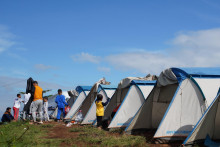
The City of Tournai has adopted a common protocol to guide the dismantling of informal migrant camps, with the aim of ensuring coordinated interventions while safeguarding the dignity and fundamental rights of the persons concerned. The protocol was developed jointly by local authorities, police and civil society organisations following discussions prompted by previous dismantling operations.
Read more
Main theme: Irregular Migration
Keywords: migrant camp, dismantling, cooperation, fundamental rights
Publication date:
According to figures published by Statbel on 10 June 2026, 69.017 persons acquired Belgian nationality in 2025. The most common previous nationalities among those who became Belgian were Moroccan, Romanian, Syrian, Polish and Italian. Compared to 2024, the number of acquisitions of Belgian nationality increased by almost 9.000.
Read more
Main theme: Citizenship & Nationality
Keywords: Belgian nationality, access to nationality

Publication date:
A draft law introducing the possibility of home searches to enforce return decisions has begun its parliamentary examination in the House of Representatives. The measure would concern certain third-country nationals subject to an enforceable return decision who do not cooperate with their return and are considered to pose a risk to public order or national security. Discussed by the Committee on Home Affairs on 16 June 2026, the proposal will be subject to consultations with experts and stakeholders before the committee continues its examination.
Read more

Publication date:
On 26 May 2026, EMN Belgium gathered over 130 key stakeholders in the fields of asylum and migration. This event also marked the launch of the Belgian Asylum and Migration Overview 2025, which highlights the principal developments in asylum and migration in Belgium over the previous year. The diverse audience of experts engaged in reflection and discussion on recent trends in the field, as well as on strengthened cooperation within the Belgian asylum and migration system. The day also included breakout session on key topics, alongside informal networking to build connections and inspire new collaborations.
Read more
Main theme: Cross-sectional, Asylum, Migration
Keywords: annual EMN policy event
Publication date:
Belgium has adopted new rules governing the renewal of residence permits for third-country national students. The amendments introduce stricter requirements concerning study progress, maximum study duration, changes of study programme and enrolment in non-recognised higher education institutions. They were adopted by Royal Decree of 7 May 2026, published in the Belgian Official Gazette on 21 May 2026, and apply from the 2026/2027 academic year.
Read more
Main theme: Student Migration
Keywords: residence permit, student, renewal, study progress, study duration, study programme

Publication date:
The Belgian Council of Ministers has approved a draft bill aimed at strengthening rules on labour migration and improving the framework for highly qualified non-EU workers. The proposal includes measures aimed at strengthening the fight against fraud linked to labour migration, while also seeking to make the European Blue Card more attractive for highly qualified workers from outside the European Union. The draft bill also provides for additional protection for workers who are victims of certain social law infringements committed by employers. The text will now be submitted to the Council of State for advice.
Read more
Main theme: Economic migration
Keywords: labour migration, highly skilled workers, EU blue card, single permit, fraud, infringement, exploitation

Publication date:
DUO for a JOB has launched a national awareness campaign highlighting the persistence of discrimination in recruitment processes in Belgium. The initiative uses the format of the well-known game “Guess Who?” to illustrate how candidates may still be excluded on the basis of appearance, name, origin or accent rather than skills. The campaign is being rolled out in May across public spaces, including stations and metro networks in several Belgian cities.
Read more
Main theme: Integration
Keywords: labour market access, discrimination, recruitment

Publication date:
On 6 May, the United Nations Human Rights Council reviewed Belgium under the Universal Periodic Review (UPR), a peer-review mechanism assessing the human rights situation in all UN Member States. The review examined the implementation of previous recommendations and the current situation across a range of policy areas, including asylum, migration and detention.
Read more
Main theme: Cross-sectional, Asylum, Migration
Keywords: Universal Periodic Review, Belgium, human rights

Publication date:
The Belgian Commissioner General for Refugees and Stateless Persons (CGRS) announces a series of changes that will apply from 12 June 2026. These changes are part of the implementation of the EU Pact on Migration and Asylum, adopted in 2024. They will affect asylum procedures, operational practices and new institutional responsibilities.
Read more

Publication date:
The Council for Alien Law Litigation (CALL) has made the use of its child-friendly courtroom (“Salle M”) a structural arrangement as of March 2026. The measure applies to asylum appeal cases involving unaccompanied minors and is accompanied by adapted summonses, age-appropriate information materials, and strengthened judicial training on children’s rights. The initiative builds on a pilot phase and forms part of broader European efforts to enhance child-friendly justice.
Read more
Main theme: Vulnerable groups, International Protection
Keywords: Council for Alien Law Litigation, unaccompanied minors, courtroom, hearing room

Publication date:
On 23 April 2026, the Belgian Chamber of Representatives adopted a bill introducing the possibility of imposing a lifetime entry ban on certain foreign nationals. The measure concerns individuals registered in the national database on terrorism, extremism and radicalisation and amends the Law of 15 December 1980 on access to the territory, residence, establishment and removal of foreign nationals.