Unaccompanied minors who have little or no perspective of receiving a residence permit within EU Member States, may have co-existing problems such as mental health issues or substance addiction. This ad hoc query examines how EU Member States deal with this specific group and how they could improve the reception and supervision of these young persons.
20/09/2022
This ad hoc query mainly collects information on calculation methods used to determine the necessary reception capacity for applicants for international protection and on the flexibility measures developed in case of shortage or surplus. It also examines how EMN Member and Observer Countries organise the outflow of beneficiaries of international protection and rejected applicants for international protection to housing and other forms of accommodation.
Theme:
Publication type:
Keywords:
12/09/2022
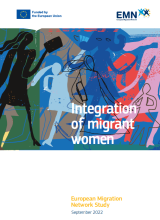
To what extent do Member States consider the distinct situation of migrant women in their integration policies and measures? This study focuses on the main areas covered by the EU Action plan on Integration and Inclusion 2021-2027 that support the integration of migrant women for example in education and training, employment and skills, health and housing as these are considered by the Action Plan the base for societal integration.

05/07/2022
What are the challenges migrants face in accessing mental health services, and how are Member States addressing them? This inform maps the policies in place to help legally-residing migrants access mental health services.

07/05/2021
From 7 until 9 July 2021, the International Migration, Integration and Social Cohesion in Europe (IMISCOE), a European network of scholars in the area of migration and integration, will hold its annual conference. The event, entitled "Crossing borders, connecting cultures", will be held entirely online.
Theme:
Type:

07/08/2020
In its Review 2019, Fedasil presents the most important events and figures on reception, voluntary return and resettlement of the past year. The overview shows an increase in the number of people entitled to reception and for whom more than 5000 temporary places were opened in 2019.

01/07/2020
In 2003, the Council adopted the Long-Term Resident Directive 2003/109/EC in order to promote the integration of third-country nationals in legal stay in the EU. Fourteen years after its entry into force, EMN Luxembourg conducted a study on the implementation of the Directive in 23 EU Member States, including Belgium.

06/11/2019
On 10 December 2019, EMN Belgium organises its annual asylum and migration policy event in which recent national and EU developments in the field of international protection, legal migration and integration and irregular migration and return will be discussed.
29/10/2019
In its latest report, the Belgian Health Care Knowledge Centre KCE has outlined the options for a more equitable access to health care for asylum seekers in Belgium.

25/10/2019
The conference 'From Tampere 20 to Tampere 2.0: Towards a new programme (2020-2024) for EU migration and asylum policies 20 years after the Tampere conclusions?' was held in Helsinki on the 24th and the 25th of October.

25/10/2019
On 22 October 2019, the Association of Flemish Cities and Municipalities (VVSG) published the results of the survey conducted in the spring of 2019. The results show that especially the search for housing for beneficiaries of international protection is very problematic. The regulations state that, in principle, they must leave the Local Reception Initiative (LOI) within two months. As in the VVSG survey of 2017, half of the respondents do not consider this period to be feasible. For almost 1 in 5, finding housing within this timeframe very exceptionally the case, and only thanks to the possibility to extend the stay in the LOI twice by 1 month.

26/07/2019
This report provides a quantitative overview of migration in rural areas for the entire EU. It contributes to raising awareness of the poorly studied phenomenon of migration to EU rural areas, which is often neglected in research and policies.
Theme:
Publication type:
Keywords:

07/05/2019
On May 27, the Organisation for Economic Co-operation and Development, European Commission and European Migration Network organise the International Conference “A New European Agenda on Migration?”. During this event, experts will share their views on the achievements, challenges and perspectives of integration and migration policies in Europe.
01/05/2019
This MPI Europe report explores the various forms of predeparture orientation programs offered by resettlement countries. It focuses on important design questions and identifies a set of features shared by effective programs.
Theme:
Publication type:
Keywords:

15/04/2019
A new report published by the Friedrich Ebert Stiftung shows how attitudes across Europe have changed before and after the 2015 migration ‘crisis’ and tries to explain what has driven those changes. Using data from the European Social Survey, the report’s authors find that, overall, perceptions of migration have remained both neutral and stable before and after the ‘crisis’. But there are a few countries that have become significantly more positive about migrants, as well as a few that have become significantly more negative.
26/02/2019
25 (Member) States provided information on inter alia the existence of civic integration policies, whether or not participation in a civic integration programme is compulsory for recognised refugees, and possible sanctions for refusing to follow such a programme.
20/02/2019
This EMN study examines the measures in place in the Member States and Norway to facilitate the integration of third-country nationals on the labour market. The study also identifies good practices from public and private actors.
Theme:
Publication type:
Keywords:

12/12/2018
On 12 December 2018, the Belgian contact point of the EMN organized its annual asylum and migration policy event in which recent national and EU developments in the field of international protection, legal migration and integration and irregular migration, human trafficking and return were discussed.
Theme:
Type:
Keywords:
03/09/2018
22 (Member) States provided information regarding their definition of the concept of vulnerability and their practices regarding the identification and the care of vulnerable applicants for international protection with special reception needs.
Theme:
Publication type:
Keywords:

01/06/2018
The results of the third sociomonitoring report, published in December 2017, will be presented by the Federal Public Service Employment and Unia, in order to better understand the situation of persons on the labour market according to their origin.
16/05/2018
One of the greatest challenges facing twenty-first century Europe is the mass migration and integration of refugees who cross borders in search of safer lives. This report of the European Foundation for Democracy analyses the wide-ranging issues relating to the integration of refugees in seven European countries, including Belgium) and presents our key findings – both in terms of good practices and areas for concern – as well as recommendations for change.

03/05/2018
The panel discussion will present the findings of the recently completed research project of the European Foundation for Democracy which examined how different European countries with high numbers of refugees and/or experience of integrating high numbers of refugees are managing the integration process and identifies good practices for integrating refugees. The research looked in particular at the situation of Syrian refugees in Europe, though not exclusively.


24/03/2018
The government approved on 24 March 2018 a new reduction plan for reception places for applicants for international protection. Today the reception network consists of 23,815 reception places. This should be reduced to 16,629 reception places in 2019, of which 10,044 collective places and 6,585 individual reception places. With this plan, the network returns to the level preceding the reception crisis.

01/02/2018
This updated report assesses how the presence of persons in need of protection affect the local communities in terms of housing, education, local economy and social responses