On 2 June 2021, the European Commission presented its new Schengen Strategy, which was accompanied by a proposal to revise the Schengen evaluation and monitoring mechanism.
Other government information and services: belgium.be
On 2 June 2021, the European Commission presented its new Schengen Strategy, which was accompanied by a proposal to revise the Schengen evaluation and monitoring mechanism.
The COVID-19 crisis has impacted the ability of international students to enrol in a HEI abroad and to travel to that country to take up studies. How did EU & OECD countries respond? Did they adapt their admission processes? An answer to these and other questions can be found in the Inform.
The outbreak of the COVID-19 pandemic and the substantial measures taken by EU and OECD countries to prevent the spread of the virus are having direct and indirect impacts on international students coming to those countries. While the long-term consequences are difficult to predict, the immediate impacts are already visible, for example, the processing of new applications or renewing of residence permits has in many cases been hindered or suspended, with consequences for international students already present in the host country. In addition, the abrupt downturn in economic activity has had a significant impact across many sectors, with international students facing the loss of their part time jobs or reduced or lost incomes, which could have an impact on their ability to continue their studies or find a job or start a business following their graduation.
Attracting students from third countries and facilitating their entry into the national labour market is a priority to the EU. The EMN has published a study on 25 EU countries’ efforts to provide opportunities for international students.
This EMN study aims to identify challenges, best practices and positive experiences in different Member States and Norway on the impact of visa liberalisation. The study covers Western Balkan and Eastern Partnership countries which have successfully concluded visa liberalisation dialogues according to the relevant action plans and roadmaps.
Today, the Commission is expanding on the concept of controlled centres as well as short-term measures that could be taken to improve the processing of migrants being disembarked in the EU, and giving a first outline of the possible way forward for the establishment of regional disembarkation arrangements with third countries.
On the 31st of May and 1st of June, the Bulgarian Contact Point of the EMN - in the framework of the Bulgarian Presidency of the Council - organized the EMN Annual Conference. The conference was dedicated to challenges and success factors in managing migration flows.
On the 31st of May and 1st of June, the Bulgarian Contact Point of the EMN - in the framework of the Bulgarian Presidency of the Council - organizes the EMN Annual Conference. The conference will be dedicated to the following topic: challenges and success factors in managing migration flows.
This publication takes stock of recent EU developments in the area of asylum, borders and external cooperation on migration.
The Royal Decree of 23 April 2018 introduced changes with regards to extending or ending the stay of international students. It details – inter alia – in which cases an order to leave the territory can be issued to a student when he/she extends his/her studies in an excessive manner considering the results.
Today, the Belgian Minister of Home Affairs, the Belgian State Secretary for Asylum Policy and Migration met with the British Home Secretary in London to discuss the issue of transit migration.
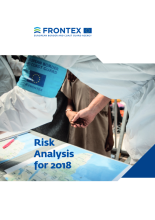
Today, Frontex published its Risk Analysis for 2018, which concentrates on the scope of Frontex operational activities and, in particular, on irregular migration at the external borders of the EU and Schengen Associated Countries.
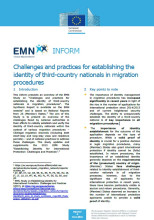
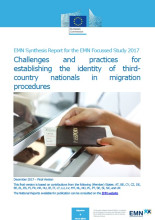
This Inform presents an overview of the EMN Study on “Challenges and practices for establishing the identity of third-country nationals in migration procedures”.
The Belgian Contact Point of the European Migration Network has published a report on challenges and practices for establishing identity in the migration process. The report served as the Belgian contribution to an EU Synthesis report on the topic, which compares national policies, legislation and practices on the subject in 25 EU Member States and Norway.
The system that will register entry, exit and refusal of entry information of third country nationals crossing the external borders of the Schengen area will come into operation, by 2020 at the latest.
Today 9 November 2017 is the last day to take part in this public consultation with a view to contributing to the revision of the legal basis of the Visa Information System.
On the 26th of October 2017 the general policy note on asylum and migration of the State Secretary for Asylum and Migration was published. The policy note provides an overview of the main achievements and priorities in the field of asylum and migration.
The European Commission published a mid-term review of what has been achieved so far in delivering the European Agenda on Migration. It also sets out new initiatives from the Commission to address key areas, and identifies where further efforts are needed in the coming months.
In order to preserve and strengthen the Schengen area, the Commission is proposing to update the Schengen Borders Code to adapt the rules for the reintroduction of temporary internal border controls to the current needs to respond to evolving and persistent serious threats to public policy or internal security.
The European Commission has launched a public consultation to collect evidence, experiences, data and opinions to support the evaluation of the existing EU legal framework for the legal entry and stay of nationals of non-EU countries to the EU Member States. The deadline is 18 September 2017.
The International Organization for Migration (IOM), published data on recent arrivals in Europe. Compared with the 273,000 migrants who landed from January through Aug. 27, 2016, about 121,000 arrived during the same period this year. Furthermore, there was no evidence of any migrant dying in the Mediterranean since Aug. 9
Following up on the Commission's Action Plan to support Italy from 4 July, the EU Trust Fund for Africa adopted today a programme worth €46 million to reinforce the integrated migration and border management capacities of the Libyan authorities.
The European Commission is today recommending that Austria, Germany, Denmark, Sweden and Norway phase out the temporary controls currently in place at some of their internal Schengen borders over the next six months.