This conference will draw on international and Irish expertise on integration to support an understanding of Ireland in a European policy context and to share evidence about what works in integration policymaking. Included will be both national and local perspectives on Irish integration.

10/09/2025
Myria is hiring a full-time Policy Officer (2-year contract) to support the Belgian Contact Point of the European Migration Network (EMN). The role focuses on economic migration and family reunification. You will contribute to English-language reports, studies, and EU-level policy work. The position is based in Brussels, with Myria as the employer.
05/11/2025
The Directorate-General for Foreign Nationals in France of the Ministry of the Interior, together with EMN France and EMN Luxembourg, organise the 4th Workshop on Forecasting and New Technologies in Migration and Asylum Governance. It will gather representatives of EU agencies, international organisations, national authorities and academia. Participants will exchange on current practices, new developments and future directions in this field.
Theme:
Type:
Keywords:
08/09/2025
Eight officers from the European Border and Coast Guard Agency (Frontex) have started work at Brussels Airport to assist in return operations. They will operate alongside Belgian police to increase the number of returns. Their deployment follows the adoption of national legislation and a Royal Decree defining their powers and operational zones.
Theme:
Type:
Keywords:
08/09/2025
Asylum applications in EU+ countries fell by nearly a quarter in the first half of 2025, according to the European Union Agency for Asylum (EUAA). A sharp decline in requests from Syrians, following political change in the country, shifted the profile of applicants across Europe. Venezuelans became the largest group seeking protection, while Germany lost its position as the main destination country. Recognition rates reached a record low, reflecting procedural factors and changes in applicant composition.
06/09/2025
This ad hoc query aims to map the processing times of work-based residence permits across EMN Member and Observer Countries, including the collection of statistics on such processing times and the existence of fast-track procedures for certain categories of employees.
Theme:
Publication type:
Keywords:

04/09/2025
On 4 September, the non-profit organisation Mentor Jeunes held an online information session for families willing to foster unaccompanied foreign minors. The initiative highlighted foster care as an alternative to collective centres, offering children a safe and structured home environment. It also explained the individualised support available to both families and young people, aiming to encourage more households to consider joining the programme.
04/09/2025
The Council of Europe Commissioner for Human Rights, Michael O’Flaherty, warns that externalised asylum and migration policies must be carefully designed to avoid serious human rights risks. His report highlights how transferring asylum, return, and border control functions to other countries can expose migrants to torture, arbitrary detention, and collective expulsions. Particular risks arise in the external processing of asylum claims, return procedures including “return hubs,” and outsourcing of border control. The Commissioner calls on states to adopt precautionary approaches, safeguard vulnerable people, and ensure transparency and accountability.
Theme:
Publication type:
Keywords:
09/10/2025
This conference aims to facilitate discussion among authorities and experts on labour migration and the response to labour market needs through sustainable and effective migration policies on a national and EU level. Selected institutions and experts will address the labour market trends and workforce needs in Cyprus and the EU, the challenges and opportunities of legal migration pathways for Cyprus, and EU best practices.
Theme:
Type:
Keywords:
01/09/2025
From 1 September 2025, the filing fee for appeals before Belgium’s Council for Alien Law Litigation will increase from €186 to €251, marking a rise of approximately 35%. The fee for parties wishing to intervene in ongoing cases will also increase, from €133 to €180. Legal practitioners are advised to inform clients of the new rates. Questions remain over the impact of these increases on access to justice for vulnerable individuals.
Theme:
Type:
Keywords:
01/09/2025
Each year, the Immigration Office publishes an activity report. This annual report presents the activities of the Immigration Office over 2024, providing figures inter alia on entry and stay, vulnerable groups, international protection, the fight against irregular migration, return, and misuse of procedures.
Theme:
Publication type:
Keywords:
31/08/2025
This ad hoc query examines whether EMN Member and Observer countries allow the revocation of temporary protection residence permits when beneficiaries are granted temporary protection in another Member State under Article 8(1) of Directive 2001/55/EC. It seeks to identify the legal provisions governing such revocation or, where applicable, alternative approaches.
Theme:
Publication type:
Keywords:
30/08/2025
Red Cross Flanders has opened 156 new cases this year concerning families who lost contact due to war, violence or migration, involving 337 individuals. The organisation works to reconnect families separated under these circumstances. Currently, 671 cases remain open in Flanders, while the international Red Cross network manages over 250.000 cases worldwide. Efforts cover more than twenty countries, including Ukraine, Afghanistan and Congo.
Theme:
Type:
Keywords:
27/08/2025
In August 2025, the European Union Agency for Asylum (EUAA) introduced a Self-Assessment Tool to help national authorities evaluate the quality of their asylum procedures. Based on EUAA operational standards and indicators, the tool provides a structured method for self-assessment. It aims to help administrations identify areas for improvement and ensure compliance with EU standards. A descriptive version of the tool is currently available to guide implementation.
Theme:
Type:
Keywords:
24/08/2025
This ad hoc query examines whether EMN Member and Observer Countries offer or intend to offer individual legal advice to applicants for international protection during the asylum procedure. It considers how the extent of need and allocation of resources are determined, whether certain sub-groups of applicants are distinguished, and what challenges and benefits arise from implementing such services.
Theme:
Publication type:
Keywords:
24/08/2025
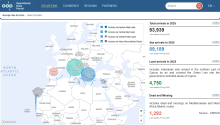
Did you know that the UNHCR Operational Data Portal provides detailed, up-to-date information on sea arrivals in Europe? As of 24 August 2025, a total of 89.189 people have reached European shores by sea. The majority of these arrivals have been recorded in Italy and Greece, while Spain also received significant numbers. In 2024, a total of 187.337 sea arrivals were reported, illustrating the continued importance of Mediterranean and North-West African routes.
Theme:
Type:
Keywords:
22/08/2025
In the first half of 2025, West Flanders saw 72 transit migrants intercepted, a significant decrease compared with previous years. Most were from Ethiopia, while earlier periods involved people from Sudan, Iraq and Vietnam. Authorities cite preventive policing and cross-border controls as key factors.
Theme:
Type:
Keywords:
20/09/2025
Fedasil is organising an exhibition on voluntary return and reintegration at the Wintercircus. The Ghent-based Magnum photographer Carl De Keyzer portrays the stories of, among others, Rosa from El Salvador and Igis from Albania. This exhibition is organised in collaboration with Caritas International and the International Organization for Migration, with the support of AMIF.
02/10/2025
This conference will explore three main areas: national policies and victim protection across Member States, strategies to address new forms of trafficking and dismantle criminal networks, and perspectives on international cooperation tools related to security. The event will bring together policymakers, experts, and civil society to discuss these challenges. Participants will also hear about the EU Strategy on combating trafficking in human beings.
18/08/2025
From 18 August 2025, new rules for family reunification enter into force in Belgium. They do not apply to all applicants. Some cases continue under the old rules, others transition to the new rules in 2027, while certain applications are immediately subject to the new framework. This article explains who is affected and how the rules will change.
Theme:
Type:
Keywords:
15/08/2025
The term “instrumentalisation of migrants” describes a strategy where countries outside the EU use the movement of people to put political pressure on the Union or one of its Member States. This has happened at several borders in recent years and has had real human consequences. A new paper from the EU Agency for Fundamental Rights (FRA) explains what the phenomenon is, the dilemmas it creates, and why responses must strike a careful balance.
Theme:
Type:
Keywords:
15/08/2025
This ad hoc query examines how EMN Member and Observer countries verify that third-country nationals applying for residence permits with the purpose of study have sufficient funds to support themselves during their stay. The query also explores trends in the issuance of residence permits for third-country national students and their family members in recent years.
Theme:
Publication type:
Keywords:
14/08/2025
This EMNews, the quarterly newsletter of the European Migration Network (EMN), offers an overview of EU and national developments in asylum and migration policy, as well as key statistics and related EMN publications for the period of April-June 2025.
12/08/2025
According to Statbel, the Belgian statistical office, 4.923 persons obtained Belgian nationality in May 2025. The main countries of origin of people who acquired Belgian nationality in May are Morocco, Romania, Syria, Turkey and Italy.
Theme:
Type:
Keywords:
08/08/2025
A European pilot project is underway to improve access to sustainable housing for beneficiaries of international protection and beneficiaries of temporary protection. Running from November 2024 to October 2027, PATHS brings together IOM, Orbit and Fedasil in Belgium, with partners in France and Greece. The initiative focuses on preventing homelessness through housing platforms, stronger intermediary organisations and greater engagement with property owners.