The Council of Europe Commissioner for Human Rights, Michael O’Flaherty, warns that externalised asylum and migration policies must be carefully designed to avoid serious human rights risks. His report highlights how transferring asylum, return, and border control functions to other countries can expose migrants to torture, arbitrary detention, and collective expulsions. Particular risks arise in the external processing of asylum claims, return procedures including “return hubs,” and outsourcing of border control. The Commissioner calls on states to adopt precautionary approaches, safeguard vulnerable people, and ensure transparency and accountability.
04/09/2025
Theme:
Publication type:
Keywords:
02/07/2025
In 2024, a total of 17.939 newcomers obtained an integration certificate in Flanders, according to the Jaarrapport Inburgering 2024. This is the highest number recorded since 2018 and marks a 16% increase compared to the previous year.
Theme:
Type:
Keywords:
27/06/2025
Nearly one in eight self-employed workers in Belgium do not hold Belgian nationality. This proportion rises to more than four in ten in the Brussels-Capital Region. An analysis of recent data from the National Institute for Social Security of the Self-Employed (INASTI) by the social insurance fund Acerta highlights these figures. The study also reveals differences in age, sector activity, and income between Belgian and non-Belgian self-employed individuals.
Theme:
Type:
Keywords:
06/06/2025
On 6 June 2025, the Flemish Government approved a communication advancing the development of pre-arrival integration trajectories for newcomers from their countries of origin. This step follows earlier pilot projects and aims to better prepare family reunification and labour migrants for life in Flanders through a digital societal orientation course.
08/04/2025
The conference will explore the future of Ukrainian displaced persons beyond temporary protection and will bring together policymakers, experts, and stakeholders to discuss strategies for policy transitions, address employment related integration challenges, share best practices, and examine the role of the diaspora in supporting long-term solutions.
Theme:
Type:
Keywords:
08/05/2025
In 2024, 19.435 people participated in the Social Orientation (Maatschappelijke Oriëntatie, MO) course in Flanders. This marks a significant increase in participation. Alongside the rising numbers of participants in the Social Orientation course, the demand for Dutch as a Second Language (NT2) courses also remains high, as evidenced by recent reports from AMAL vzw, Atlas Antwerp, and the Agency for Integration and Civic Integration.
01/05/2025
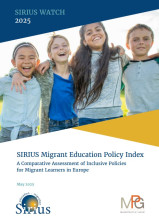
The 2025 SIRIUS Migrant Education Policy Index introduces a novel framework for evaluating inclusive education policies across 15 EU Member States. Structured around seven key dimensions, the Index highlights existing disparities and effective practices in supporting migrant learners. It underscores the urgent need for systemic reforms to ensure equitable and high-quality education for all students, regardless of migration background. The report advocates for a learner-centred approach prioritising structural flexibility, cultural and linguistic inclusion, and coordinated policy interventions.
Theme:
Publication type:
Keywords:
01/05/2025
On the occasion of Labour Day, Fedasil published new figures on the professional activity of applicants for international protection residing in reception centres. In 2024, 41% of those allowed to work were active on the Belgian labour market. The data show differences in employment rates depending on gender, age, and nationality.
Theme:
Type:
Keywords:
17/04/2025
This ad hoc query explores how EMN Member and Observer Countries support legally residing migrant children (third-country nationals) in adapting to the cultural environment of primary and secondary schools. It focuses on national measures, including language support, teacher training, targeted initiatives, and the use of specific educational tools. It also examines challenges, good practices, and whether countries monitor migrant children's academic performance.
Theme:
Publication type:
Keywords:
10/04/2025
The Education Department of Caritas International Belgium, in collaboration with the non-profit organisation Sankaa, has launched "Building Bridges", an educational resource for secondary school teachers. This resource helps educators address key topics such as identity, prejudice, racism, and media representation. At its core, "Building Bridges" explores the central question: How can we create a more supportive and inclusive society where everyone has a place?
Theme:
Type:
Keywords:
10/04/2025
This ad hoc query, which informed the preparation of an EMN Inform, collected information on how Member and Observer Countries organise vocational education and training (VET) for applicants and beneficiaries of international protection. It covers programme structures, admission conditions, support measures, incentives, obligations, and the recognition of prior skills, as well as good practices and key challenges in delivering VET.
20/03/2025
This ad hoc query examines the initiatives in place across EMN Member and Observer Countries to encourage employers to participate in the integration of their employees.
Theme:
Publication type:
Keywords:
Improving the Economic Migration Framework to Attract and Retain Qualified Talent in Flanders (OECD)
01/03/2025
This report provides a diagnosis of the strengths and weaknesses of the Flemish framework for management of economic migration and recommendations for possible areas of reform. The report also presents some of the first empirical analyses of retention and outcomes of economic migrants in Flanders.
Theme:
Publication type:
Keywords:

19/02/2025
About sixty Eritrean refugees gathered in front of the Town Hall in Ghent to draw the authorities' attention to the impact of the housing crisis on their situation and integration prospects. The authorities expressed their intention to find solutions but called on Minister of Asylum and Migration Anneleen Van Bossuyt to address this issue together. They also stated that they would consider a European response to this widespread problem.

28/01/2025
During this Networking Day, participants will examine ways to increase housing opportunities for newcomers. Through three workshops and a panel discussion, participants will bring together their experiences and expertise in the field.
04/02/2025
In a recent judgment, the Court of Justice of the European Union (CJEU) held that national legislation may oblige beneficiaries of international protection to pass a civic integration examination. However the fact of having failed such an examination cannot be systematically penalised by a fine.
28/01/2025
The purpose of this conference is to address the situation of migrant women in Spain and in other Member states, highlighting the challenges and problems they face and what measures are being taken to ensure their integration and inclusion, especially with regard to access to the labour market and housing.
19/12/2024
This ad hoc query examines the existence of national initiatives across EMN Member and Observer Countries to support parents of allophone children to navigate the schooling system in order to improve their children’s academic success and overall integration in their host society.
Theme:
Publication type:
Keywords:
12/11/2024
EMN France's national conference will focus on the recent Inform published jointly by the EMN and OECD, which provides an overview of civic training schemes/programmes for third-country nationals in EMN Member and Observer Countries, and in non-EU OECD countries. It will also discuss educational approaches, systems and exams in place to convey and assess knowledge of civic principles and values.
Theme:
Type:
Keywords:
18/10/2024
The 2024 national conference of EMN Finland shall examine the state of play as well as the future prospects of the situation of Ukrainians in Finland and in EU countries. The conference aims to address the challenges of integration in a situation where beneficiaries of temporary protection find themselves between two countries. The conference seeks to support these persons in the limbo between integration and return.
26/11/2024
On 26 November 2024, the European Commission launched a new programme to support a Talent Partnership between the EU and Pakistan. The programme, that is funded with EUR 3 million from the EU, will enable the EU, its Member States, and Pakistan to develop a coherent set of actions on labour mobility and skills development.
Theme:
Type:
Keywords:
11/10/2024
This conference is dedicated to exploring how to maximize the benefits of external cooperation in the field of migration. A wide range of national and international experts, including policymakers from EU and non-EU countries, practitioners and researchers, will engage in discussions around the challenges and components of effective migration partnerships, exploring opportunities for balanced as well as comprehensive cooperation and innovative approaches.
Theme:
Type:
Keywords:
15/11/2024
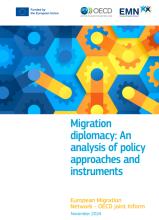
This Inform by the European Migration Network (EMN), in collaboration with the Organisation for Economic Co-operation and Development (OECD), sheds light on the role of migration diplomacy in fostering international cooperation for effective migration management. It highlights the diplomatic tools, practices, and challenges involved in migration diplomacy across EMN Member and Observer countries with examples from OECD countries.
Theme:
Publication type:
Keywords:
26/09/2024
This conference aims to present the first results of a Fedasil-funded mentoring-to-work project for highly skilled asylum seekers. It will discuss the challenges and opportunities of using mentoring as a pre-integration tool for asylum seekers. It will also explore the added value of mentoring for those who receive a positive decision and the challenges that arise from working with status holders.

21/10/2024
On 21 October 2024, the European Ombudsman closed her inquiry on respect for human rights in the context of the EU-Tunisia Memorandum of Understanding (MoU). She concluded, inter alia, that the Commission should set out the criteria on which the suspension of contracts due to violations of human rights in the implementation of EU-funded projects in Tunisia would be based. These criteria should be made public.