The Flemish government has decided that third-country workers – from outside the EU, Iceland, Liechtenstein, Norway and Switzerland – will follow a mandatory tailored integration trajectory from 2027. The initiative, proposed by Minister Hilde Crevits, will be delivered digitally and can be started in the country of origin or within six months of arrival in Flanders. The programme provides essential information on work, rights and responsibilities, and Flemish norms and values. Certain temporary or seasonal workers, students, and holiday-work participants are excluded.
27/09/2025
This ad hoc query maps the use of positive and negative incentives to encourage participation of beneficiaries of international protection in civic integration activities or civic integration programmes across EMN Member and Observer Countries.
Theme:
Publication type:
Keywords:
26/09/2025
The Fedasil Info Point in Brussels has been supporting asylum seekers and other migrants for two years, providing accessible and centralised information in one location. Since reopening on 27 September 2023 at the former Bordet Hospital site, it has welcomed over 22.000 visitors, mostly single men with ongoing asylum procedures. Visitors most frequently ask about accommodation, medical care, legal support, and other practical matters. Partners such as Caritas International and the European Union Agency for Asylum (EUAA) assist in providing guidance and support.
26/09/2025
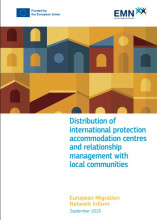
This Inform examines how international protection applicants and accommodation centres are distributed across 23 EMN Member Countries and Serbia, and how such policies are governed and managed. It compares approaches, criteria and mechanisms used by different countries, highlighting both challenges and good practices. The study also looks at how local communities and stakeholders are informed and engaged in the process. Finally, it identifies opportunities for further collaboration to support effective reception and integration.
Theme:
Publication type:
Keywords:
Minister Van Bossuyt updates Parliament on internal checks against irregular and secondary migration
17/09/2025
Belgium introduced targeted internal checks in July 2025 to address irregular and secondary migration. The measures are applied at airports, international bus and rail stations, and motorway rest areas. Over 11.000 individuals have been checked, with some ordered to leave the territory or placed in closed centres. The government plans to continue the checks and to conduct a six‑month evaluation.
10/04/2025
The EU Commission launched a call for proposals under the Asylum, Migration and Integration Fund (AMIF) to finance projects aiming to improve healthcare access for migrants, support migrant women through better labour market integration, enhance digital literacy, create accessible education, ensure the protection of migrant children. The available call budget is EUR 34 million.
24/08/2025
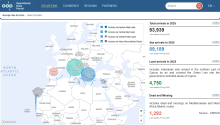
Did you know that the UNHCR Operational Data Portal provides detailed, up-to-date information on sea arrivals in Europe? As of 24 August 2025, a total of 89.189 people have reached European shores by sea. The majority of these arrivals have been recorded in Italy and Greece, while Spain also received significant numbers. In 2024, a total of 187.337 sea arrivals were reported, illustrating the continued importance of Mediterranean and North-West African routes.
Theme:
Type:
Keywords:
22/08/2025
In the first half of 2025, West Flanders saw 72 transit migrants intercepted, a significant decrease compared with previous years. Most were from Ethiopia, while earlier periods involved people from Sudan, Iraq and Vietnam. Authorities cite preventive policing and cross-border controls as key factors.
Theme:
Type:
Keywords:
02/07/2025
In 2024, a total of 17.939 newcomers obtained an integration certificate in Flanders, according to the Jaarrapport Inburgering 2024. This is the highest number recorded since 2018 and marks a 16% increase compared to the previous year.
Theme:
Type:
Keywords:
27/06/2025
Nearly one in eight self-employed workers in Belgium do not hold Belgian nationality. This proportion rises to more than four in ten in the Brussels-Capital Region. An analysis of recent data from the National Institute for Social Security of the Self-Employed (INASTI) by the social insurance fund Acerta highlights these figures. The study also reveals differences in age, sector activity, and income between Belgian and non-Belgian self-employed individuals.
Theme:
Type:
Keywords:
24/06/2025
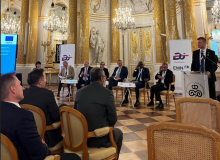
On 24 June 2025, EMN Belgium participated in the Polish Presidency Conference on countering irregular migration. The discussions examined this phenomenon from three perspectives: strengthening the EU’s external borders to prevent irregular entries, combating migrant smuggling to dismantle criminal networks, and addressing the root causes of irregular migration and providing safe and legal alternatives.
04/04/2025
This high-level conference will provide panel discussions among EU Member States’ ministries, the European Commission, EU agencies, national stakeholders, international organisations, and third-country officials to exchange views on tackling irregular migration, border management, countering migrant smuggling, and addressing root causes of migration.
Theme:
Type:

19/06/2025
On 19 June 2025, Interior Minister Bernard Quintin and Asylum and Migration Minister Anneleen Van Bossuyt announced that, starting from summer 2025, federal police, local police, and the Immigration Office will collaborate to conduct targeted checks within Belgium. These measures aim to combat irregular migration and secondary movements towards Belgium. Reactions have emerged regarding the capacity required to implement such checks, their actual effectiveness in reducing irregular migration, and whether they can deliver a real deterrent effect or remain largely symbolic.
06/06/2025
On 6 June 2025, the Flemish Government approved a communication advancing the development of pre-arrival integration trajectories for newcomers from their countries of origin. This step follows earlier pilot projects and aims to better prepare family reunification and labour migrants for life in Flanders through a digital societal orientation course.
03/06/2025
On 3 June 2025, the Court of Justice of the European Union (CJEU) delivered a judgment clarifying the scope of the offence of facilitation of unauthorised entry into the EU. The Court ruled that a third-country national cannot be criminally penalised for bringing minors under their care into an EU Member State, even if this entry breaches border rules. This decision emphasises the protection of family responsibilities and fundamental rights within EU law.
01/06/2025
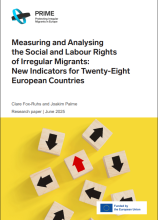
This research paper introduces the "IRMIGRIGHT", the first bespoke database of social and labour rights of irregularly staying migrants in twenty-eight European countries. A number of findings emerge from the data analysis, including the fact that, on average, irregularly staying migrants have significantly weaker social rights than labour rights.
Theme:
Publication type:
Keywords:
08/04/2025
The conference will explore the future of Ukrainian displaced persons beyond temporary protection and will bring together policymakers, experts, and stakeholders to discuss strategies for policy transitions, address employment related integration challenges, share best practices, and examine the role of the diaspora in supporting long-term solutions.
Theme:
Type:
Keywords:
13/05/2025
According to preliminary data published by Frontex, the number of irregular border crossings into the European Union decreased by 27% between January and April 2025, compared to the same period in 2024. Nearly 47.000 crossings were detected during the first four months of 2025.
12/05/2025
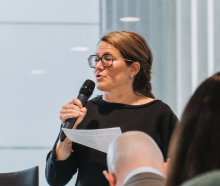
On 11-12 May 2025, Belgian Minister for Asylum and Migration Anneleen Van Bossuyt visited Chisinau to emphasise that asylum applications from Moldovan nationals—coming from a country considered safe—are processed through an accelerated procedure in Belgium. She also announced the immediate discontinuation of the return incentive, which is seen as encouraging misuse of the asylum system.
08/05/2025
In 2024, 19.435 people participated in the Social Orientation (Maatschappelijke Oriëntatie, MO) course in Flanders. This marks a significant increase in participation. Alongside the rising numbers of participants in the Social Orientation course, the demand for Dutch as a Second Language (NT2) courses also remains high, as evidenced by recent reports from AMAL vzw, Atlas Antwerp, and the Agency for Integration and Civic Integration.
01/05/2025
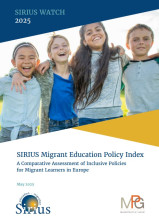
The 2025 SIRIUS Migrant Education Policy Index introduces a novel framework for evaluating inclusive education policies across 15 EU Member States. Structured around seven key dimensions, the Index highlights existing disparities and effective practices in supporting migrant learners. It underscores the urgent need for systemic reforms to ensure equitable and high-quality education for all students, regardless of migration background. The report advocates for a learner-centred approach prioritising structural flexibility, cultural and linguistic inclusion, and coordinated policy interventions.
Theme:
Publication type:
Keywords:
01/05/2025
On the occasion of Labour Day, Fedasil published new figures on the professional activity of applicants for international protection residing in reception centres. In 2024, 41% of those allowed to work were active on the Belgian labour market. The data show differences in employment rates depending on gender, age, and nationality.
Theme:
Type:
Keywords:
17/04/2025
This ad hoc query explores how EMN Member and Observer Countries support legally residing migrant children (third-country nationals) in adapting to the cultural environment of primary and secondary schools. It focuses on national measures, including language support, teacher training, targeted initiatives, and the use of specific educational tools. It also examines challenges, good practices, and whether countries monitor migrant children's academic performance.
Theme:
Publication type:
Keywords:
10/04/2025
The Education Department of Caritas International Belgium, in collaboration with the non-profit organisation Sankaa, has launched "Building Bridges", an educational resource for secondary school teachers. This resource helps educators address key topics such as identity, prejudice, racism, and media representation. At its core, "Building Bridges" explores the central question: How can we create a more supportive and inclusive society where everyone has a place?
Theme:
Type:
Keywords:
10/04/2025
This ad hoc query, which informed the preparation of an EMN Inform, collected information on how Member and Observer Countries organise vocational education and training (VET) for applicants and beneficiaries of international protection. It covers programme structures, admission conditions, support measures, incentives, obligations, and the recognition of prior skills, as well as good practices and key challenges in delivering VET.