Publication date:
This launch event will unveil the new EMN - Red Cross Inform on "Practices and challenges in processing victims of torture and ill-treatment in the context of international and temporary protection". The event will highlight key findings from the Inform, present examples of procedures put in place in EMN Member and Observer Countries, and draw insights from the Red Cross approach and experience of National Red Cross Societies in different EU Member States.
Read more
Main theme: Vulnerable groups
Keywords: torture, ill-treatment, victim, international protection, temporary protection

Publication date:
The current weather conditions increase the risk that human smugglers will send groups of transmigrants, including small children, out to sea in overcrowded rubber boats, often with inadequate life jackets. To avoid this, the West Coast police zone and the Federal Police require special attention for people who cross the Channel from the Belgian coast to the United Kingdom in small boats.
Read more
Main theme: Smuggling & Trafficking
Keywords: transmigrant, small boat, English channel
Publication date:
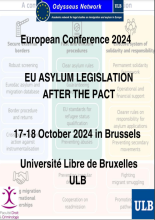
This legally oriented European conference focuses on the legislation adopted on 14 May 2024 under the framework of the Pact on Migration and Asylum. It aims to provide the first legal analysis of all these complex legal instruments and their interconnections, including practical aspects in relation with the topics covered.
Read more
Main theme: Cross-sectional
Keywords: Odysseus Network, New Pact on Migration and Asylum


Publication date:
While not a new phenomenon, the exploitation of workers employed in the nail industry has gained increased attention in recent years. Multiple reports point to this sector as being a target of choice for human trafficking and economic exploitation.
Read more
Main theme: Smuggling & Trafficking
Keywords: economic exploitation, nail bar
Publication date:
According to Statbel, the Belgian statistical office, 5.037 persons obtained Belgian nationality in May 2024. The main countries of origin of people who acquired Belgian nationality in May are Morocco, Romania, Syria, Afghanistan and Turkey.
Read more
Main theme: Data & Statistics
Keywords: access to nationality, Belgian nationality
Publication date:
As of 1 August 2024, the European Commission will support nine Member States, including Belgium, in preparing their National Implementation Plans for the Pact on Migration and Asylum. These countries will receive targeted support to carry out situational analysis and identify the necessary actions to implement the Pact in line with the Common Implementation Plan.
Read more

Publication date:
The latest report from the EU Agency for Fundamental Rights (FRA) identifies systemic gaps and obstacles to investigating rights violations at EU borders. The report suggests concrete steps to ensure more effective investigations into incidents of loss of life and ill-treatment at the EU’s borders.
Read more
Main theme: Borders & Visa
Keywords: fundamental rights, violation, investigation, external border

Publication date:
Tuesday 30 July is the International Day against Trafficking in Persons. On this occasion, the Halle-Vilvoorde public prosecutor's office, together with the Labour Auditor's Office, invite as many people as possible to be vigilant and to report suspicious situations via the Belgian helpline for victims of human trafficking or via the new telephone number: 078/055.800.
Read more
Main theme: Smuggling & Trafficking
Keywords: victim of trafficking, national helpline

Publication date:
This election year will be the fourth time that non-Belgians who reside in Belgium can vote in municipal elections. Yet participation remains low, as shown by the figures released by the FPS Interior ahead of the registration deadline, on 31 July 2024.
Read more
Main theme: Integration
Keywords: election, vote, foreign national

Publication date:
In a judgement from 29 July 2024, the Court of Justice of the EU states that a Member State may reject an abusive application for an authorisation to reside on its territory for the purpose of study, even if it has not correctly transposed the directive that provides for that option.
Read more
Main theme: Student Migration
Keywords: abusive application, abusive practice, abusive intention, study
Publication date:
This capacity-building workshop, organised jointly by EMN Luxembourg and the Prague Process, aims to explore the current state of forecasting migration and asylum flows, address existing challenges, and consider the future of forecasting in migration management. Additionally, the workshop will showcase the latest technological advancements in migration, asylum, and data-driven societies and discuss prospects for their implementation in national and regional contexts.
Read more
Main theme: Data & Statistics
Keywords: forecasting, migration trend, asylum flow, predictive analysis
Publication date:
EMN Italy organises a national conference laying focus on attracting international talent and skilled labor and on fostering co-development between Member States and third countries. Through an exchange of experiences and best practices, the legal framework and challenges in this matter will be discussed.
Read more
Main theme: Economic migration
Keywords: talent mobility, skilled migrants
Publication date:
In a press release from 26 July 2024, Myria, the Federal Migration Centre, calls on the authorities, given the scale of the humanitarian catastrophe in Gaza, to make greater efforts in terms of information provision and administrative and procedural flexibility, both in terms of access to evacuation and the submission and processing of visa applications.
Read more
Main theme: Cross-sectional
Keywords: short-stay visa, long-stay visa, family reunification, Gaza
Publication date:
Before 8 October 2024, public bodies or a public or non-public implementing agency or body of a Member State can apply for funding and submit their proposal to support the implementation of the Global Alliance to Counter Migrant Smuggling and its call to action to strengthen international cooperation on preventing and responding to migrant smuggling.
Read more
Main theme: Smuggling & Trafficking
Keywords: call for proposals, migrant smuggling, global alliance to counter migrant smuggling
Publication date:
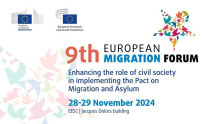
Civil society organisations are invited to apply before 12 September 2024 to contribute to the 9th European Migration Forum (EMF) under the theme "Enhancing the role of civil society in implementing the Pact on Migration and Asylum".
Read more
Main theme: Cross-sectional
Keywords: European Migration Forum, New Pact on Migration and Asylum, civil society

Publication date:
On 22 July 2024, the Minister of Justice officially launched the Blue Heart Campaign at the Antwerp city hall. EMN Belgium joined local authorities, the three specialised centres for victims of human trafficking, Myria, the Social Intelligence and Investigation Service and the IOM on this occasion. As one in three victims of human trafficking globally is a child, this year's global campaign urges accelerated action to end child trafficking.
Read more
Main theme: Smuggling & Trafficking
Keywords: blue heart campaign, child victim of trafficking, victims of human trafficking
Publication date:
In the 2024 Rule of Law Report, especially in the country chapter on the rule of law situation in Belgium, the European Commission recommends that Belgium takes measures to ensure compliance by public authorities with final rulings of national courts and the European Court of Human Rights, referring in particular to judgments finding the State responsible for not ensuring adequate reception of asylum seekers.
Read more
Main theme: Reception
Keywords: rule of law, reception, applicant for international protection
Publication date:
With 401 votes in favour, 284 against, and 22 cast blank or invalid votes, the European Parliament elected Ursula von der Leyen as President of the European Commission on 18 July. She presented her Political Guidelines for the next European Commission 2024-2029, referring inter alia to security, external borders, and migration management.
Read more
Main theme: Cross-sectional
Keywords: European Commission, President, Europol, Frontex, European Border and Coast Guard, New Pact on Migration and Asylum

Publication date:
On 14 July 2024, the revised EU Anti-Trafficking Directive enters into force with stronger rules to fight trafficking in human beings. The revised Directive introduces stricter criminalisation and provides stronger tools for public authorities to investigate and prosecute new forms of exploitation, including those that take place online, and ensure better assistance and support to victims.
Read more
Main theme: Smuggling & Trafficking
Keywords: Anti-Trafficking Directive
Publication date:
The number of irregular border crossings into the European Union in the first six months of 2024 fell to roughly 94.000, according to preliminary data collected by Frontex. The Western Balkans and the Central Mediterranean recorded the largest decreases in detections of irregular border crossings, while the West African and the Eastern Land Border have seen the largest increases.
Read more
Main theme: Borders & Visa
Keywords: Frontex, European Border and Coast Guard, irregular border crossing
Publication date:
During a webinar followed by around 160 participants, the European Migration Network (EMN) and Eurostat launched the Annual Report on Migration and Asylum for 2023 and the accompanying Statistical Annex. Key highlights from the report were outlined as well as key figures to support policy-making and monitoring. National perspectives were also shared by Finland and Serbia.
Read more
Main theme: Cross-sectional
Keywords: annual report
Publication date:
On 9 July, almost 100 NGOs, which include ECRE and several ECRE member organisations, published a joint statement urging all EU Member States to guarantee the right to seek and enjoy asylum and uphold their commitments to the international refugee protection system.
Read more
Main theme: International Protection
Keywords: application for international protection, outsourcing, externalisation
Publication date:
According to Statbel, the Belgian statistical office, 4.988 persons obtained Belgian nationality in April 2024. The main countries of origin of people who acquired Belgian nationality in April are Morocco, Syria, Romania, Afghanistan and Turkey.
Read more
Main theme: Data & Statistics
Keywords: access to nationality, Belgian nationality
Publication date:
According to recent figures published by Eurostat, Belgium sent 14.079 outgoing requests using the Dublin procedure, thus appearing in the top 5 countries that sent 86% of all outgoing requests in 2023. Belgium also reported 1.241 outgoing transfers in 2023.