Publication date:
From 2014 to 2023, Esperanto provided shelter and support to 156 foreign minors victims of human trafficking and/or aggravated smuggling. According to Myria, who analysed the figures, just over half of these 156 young people were victims of sexual exploitation or were forced to commit criminal acts.
Read more
Main theme: Smuggling & Trafficking
Keywords: child victim of trafficking, sexual exploitation, economic exploitation, exploitation of begging, Esperanto

Publication date:
Nicole de Moor said that applications relating to 859 persons have already been processed in accelerated procedure since February 2024. In 96 % of cases, applicants were not granted protection status. Ms de Moor wants to focus more on prevention to prevent people who do not need protection from applying for international protection in Belgium.
Read more

Publication date:
In its overview of national forced return monitoring systems across the EU in 2023, the EU Agency for Fundamental Rights (FRA) noted that only one EU Member State did not monitor its national forced return operations in 2023. It also highlighted persistent challenges that affect the transparency and effectiveness of monitoring operations.
Read more
Main theme: Return & Readmission
Keywords: forced return, monitoring

Publication date:
On 28 October 2024, the European Commission and the Ministry of Interior of North Macedonia signed an Administrative Arrangement to collaborate in the European Migration Network, making North Macedonia one of the network’s Observer Countries. North Macedonia will contribute to the European Migration Network’s objectives, attending all meetings and contributing to the network’s studies and reports.
Read more
Main theme: Cross-sectional
Keywords: European Migration Network, observer country

Publication date:
As of 24 October 2024, the centre for registering applications for international protection is located at rue Belliard 68 in 1000 Brussels. Applications can still be registered in the Pacheco building until Wednesday, 23 October 2024.
Read more
Main theme: International Protection
Keywords: applicant for international protection, registration, registration centre
Publication date:
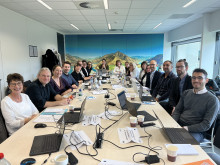
The Glossary Working Group meets regularly to maintain the EMN Asylum and Migration Glossary up to date. This 62nd meeting, hosted by EMN Belgium, was an opportunity to discuss cooperation with partners, especially in preparation of the inclusion of new terms related to the Pact on Migration and Asylum.
Read more
Main theme: Cross-sectional
Keywords: glossary, New Pact on Migration and Asylum

Publication date:
On the occasion of European Anti-Trafficking Day, the Council of Europe’s Group of Experts on Action against Trafficking in Human Beings (GRETA) has warned of the increased risk of human trafficking created by restrictive immigration policies and failure to address the vulnerabilities of migrants and asylum seekers.
Read more
Main theme: Smuggling & Trafficking
Publication date:
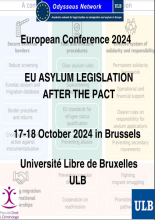
On 17-18 October 2024, EMN Belgium participated in the Odysseus Network Conference 2024 on EU Legislation after the Pact. This event offered EMN Belgium the opportunity to gain an in-depth understanding of some of the 485 pages included in the new legal instruments introduced by the New Pact on Migration and Asylum.
Read more
Main theme: Cross-sectional
Keywords: New Pact on Migration and Asylum, implementation, solidarity, responsibility sharing, border, screening, fundamental right

Publication date:
The 2024 national conference of EMN Finland shall examine the state of play as well as the future prospects of the situation of Ukrainians in Finland and in EU countries. The conference aims to address the challenges of integration in a situation where beneficiaries of temporary protection find themselves between two countries. The conference seeks to support these persons in the limbo between integration and return.
Read more
Main theme: Integration, Temporary protection, Return & Readmission
Keywords: beneficiary of temporary protection, Ukraine, legal status, voluntary return
Publication date:
During the European Council on 17 October 2024, EU leaders adopted conclusions, among other things, on migration. They called, inter alia, for determined action to facilitate, increase, and speed up returns from the EU. They invited the European Commission to submit a new legislative proposal, as a matter of urgency.
Read more
Main theme: Cross-sectional
Keywords: return directive, external action, external border, border control, migration instrumentalization
Publication date:
In a recent judgment, the Court of Justice of the European Union found that an administrative authority which rejects an application for a residence permit based on national law and, consequently, finds that the third-country national concerned is staying illegally on the territory of the Member State in question, must ensure compliance with the principle of non-refoulement, by reviewing, in the light of that principle, the return decision previously adopted against that national in the context of a procedure for international protection.
Read more
Main theme: Return & Readmission
Keywords: illegally staying person, return decision, non-refoulement, effective remedy

Publication date:
In view of the current preparation of the National Implementation Plans due by December 2024, EMN Greece aims to facilitate a stimulating discussion and interesting exchange of views on the implementation of the new Pact on Migration and Asylum during its national conference 2024.
Read more
Main theme: Cross-sectional
Keywords: New Pact on Migration and Asylum

Publication date:
According to preliminary data collected by Frontex, the most significant declines in irregular border crossings were observed on the Western Balkan and Central Mediterranean routes, with a 79% and 64% decline, respectively. The Eastern Land Border and Western African routes saw the highest increases, at 192% and 100%, respectively.
Read more
Main theme: Borders & Visa
Keywords: irregular border crossing, migratory route
Publication date:
In a letter to the 27 EU Member States, Ursula von der Leyen announced that the Commission will present a new proposal for legislation to ensure solid rules for the removal of irregularly staying third-country nationals, including those posing a threat to public order or internal security. She also referred to possible "return hubs" outside the EU, drawing lessons from the start of operations of the Italy-Albania protocol.
Read more
Main theme: Cross-sectional
Keywords: efficient return, return hub, mutual recognition of return decisions, security

Publication date:
The Polish National Contact Point to the European Migration Network (EMN) will hold its national conference in 2024 on "Security of the EU's External Borders: Development of systems, technologies and threats prevention".
Read more
Main theme: Borders & Visa
Keywords: external border, border security, technology
Publication date:
According to Statbel, the Belgian statistical office, 5.806 persons obtained Belgian nationality in July 2024. The main countries of origin of people who acquired Belgian nationality in July are Morocco, Romania, Syria, Afghanistan and Italy.
Read more
Main theme: Data & Statistics
Keywords: access to nationality, Belgian nationality

Publication date:
What does the EU Pact on Migration and Asylum actually mean for Belgian migration and asylum procedures? This study day will allow lawyers, magistrates and all legal practitioners to consider this question, benefiting from the contributions and insights of experts from national migration and asylum authorities, various non-governmental organisations, and several universities.
Read more
Main theme: Cross-sectional
Keywords: New Pact on Migration and Asylum, asylum procedure, right of residence
Publication date:
Fedasil has a budget for financing specific projects relating to the reception of asylum seekers (and other reception beneficiaries). The Agency has launched its call for projects for the year 2025. In 2025, the focus will be on projects that focus on support, activation, and housing.
Read more
Main theme: Reception
Keywords: call for projects, applicant for international protection, support, activation, housing
Publication date:
EU Commissioner Ylva Johansson announced that the Entry-Exit System (EES) which aims to modernise EU border management and which was supposed to start on 10 November 2024, has been postponed with no new date set. Ms Johansson suggested that the EU may roll out the EES gradually.
Read more
Main theme: Borders & Visa
Keywords: entry exit system, border management, biometric check
Publication date:
A few days after 17 European countries called on the European Commission to submit a new legislative proposal for more effective returns, Justice and Home Affairs Ministers discussed the issue of return during a working lunch in Luxembourg. They tasked experts with starting to explore innovative ideas related to returns.
Read more
Main theme: Return & Readmission
Keywords: effective return, irregularly staying third-country national, rejected asylum seekers

Publication date:
During the plenary debate on the reintroduction of internal border controls in the Schengen area and its impact on EU free movement, Commissioner Ylva Johansson underlined that internal border controls must be temporary, proportionate and a measure of last resort. She underlined that alternative measures should always be prioritised.
Read more
Main theme: Borders & Visa
Keywords: free movement, internal border control
Publication date:
In a recent judgement in Case C‑134/23, the Court of Justice of the European Union (CJEU) clarified that Article 38 of Directive 2013/32/EU does not preclude legislation of a Member State designating a third country as generally safe for certain categories of applicants for international protection, even if that third country has suspended, in general terms and without any prospect of a contrary development, the admission or readmission of those applicants to its territory.
Read more
Main theme: International Protection
Keywords: applicant for international protection, safe third country, Turkey, readmission
Publication date:
In a recent judgement, the Court of Justice of the European Union concluded that some of the discriminatory measures against women in Afghanistan, namely forced marriage and the lack of protection against gender-based violence and domestic violence, must be classified alone as "acts of persecution" and that other measures, taken as a whole, given their cumulative effect and the fact that they are applied deliberately and systematically, constitute such acts.
Read more
Main theme: International Protection
Keywords: Afghan woman, act of persecution, gender, nationality
Publication date:
In a non-paper, seventeen European countries called on the European Commission to submit a new proposal for more effective returns. The letter emphasises the need for a stricter EU return system with clearer obligations for cooperation from the returnees and less interpretation by the European Court of Justice.
Read more
Main theme: Return & Readmission
Keywords: effective return

Publication date:
This conference, organised jointly by EMN Estonia and IOM Estonia, focuses on labour shortages in the EU. It will offer insights into sustainable strategies to balance local labour demands while remaining competitive and attractive to migrant workers.