
Publication date:
If you want to learn more about key migration and asylum trends in 2023, join this EMN event! It will shed light on both EU and national perspectives, featuring insights from Eurostat on recent trends and statistics, and a national perspective from EMN Members and Observer Countries.
Read more
Main theme: Cross-sectional
Keywords: Annual Policy Report
Publication date:
From 1 July 2024, adult asylum seekers who stay in a reception centre and who have a working income will have to contribute to this reception. Those who do not wish to contribute may consider staying outside the reception centre. They are free to leave the centre and find their own accommodation.
Read more
Main theme: Reception
Keywords: reception centre, financial contribution, material assistance
Publication date:
On 1 July 2024, Hungary took over the rotating presidency of the Council of the European Union for a duration of six months. Among the country’s seven priorities for its EU presidency are " stemming illegal migration” and bringing the Western Balkans countries “one step closer” to EU membership.
Read more
Main theme: Irregular Migration
Keywords: Hungarian Presidency
Publication date:
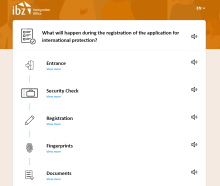
The Immigration Office disclosed a new website aimed at informing applicants for international protection about the purpose and course of the registration. Each step of the process is explained in 16 languages via texts, audio, and videos. The website was co-funded by the European Union.
Read more
Main theme: International Protection
Keywords: registration, application for international protection
Publication date:
According to Eurostat, the number of people returned to another country increased by 11% in the first quarter of 2024 compared with the same quarter of 2023. In comparison with the previous quarter (fourth quarter of 2023), the number of returns went up by 6%.
Read more
Main theme: Data & Statistics
Keywords: order to leave the territory, return, law enforcement
Publication date:
In order to structurally shorten the duration of reception in Belgium, an amendment was made to the Reception Act. Anyone who receives a final negative asylum decision must leave the reception place within a period of 30 days.
Read more
Main theme: Reception
Keywords: reception centre, material assistance

Publication date:
On 25 and 26 June 2024, EMN Belgium and its partners organised a high-level conference to present the Pact and outline subsequent steps for its implementation. The event, which convened 400 representatives from pivotal institutions and organisations, highlighted the opportunities and challenges associated with the Pact as well as the need and potential for partnerships in effectively implementing it.
Read more

Publication date:
The Federal Judicial Police reveals that unaccompanied foreign minors in Belgium and throughout Europe are recruited by criminal organisations and forced to carry out theft or drug trafficking. The Federal Police draws attention to this invisible phenomenon and asks to make it a priority for action.
Read more
Main theme: Vulnerable groups
Keywords: unaccompanied minors, forced criminality
Publication date:
On 13 June 2024, the Council of the European Union agreed its position on the proposal for an EU Talent Pool to facilitate the recruitment of talent from third countries who live outside the EU, to make the EU labour market more competitive and to tackle shortages on the European labour market.
Read more
Main theme: Economic migration
Keywords: EU Talent Pool, shortage occupation, talent mobility
Publication date:
During the last Justice and Home Affairs Council under the Belgian Presidency, Ministers agreed to extend the temporary protection for Ukrainians for one year. This will run until March 2026.
Read more
Main theme: Cross-sectional, Asylum, Migration
Keywords: temporary protection, Ukraine, visa policy, Schengen, border control, interoperability

Publication date:
On 13 June 2024, the Court of Justice of the European Union released its judgment in the case C-563/22 involving a stateless Palestinian mother and her child, registered with UNRWA, who left the Gaza strip to seek protection in Bulgaria. In this case, the Court provided guidance on the interpretation of Article 12(1)(a) of Directive 2011/95/EU and of Article 40(1) of Directive 2013/32/EU.
Read more
Main theme: International Protection
Keywords: refugee status, exclusion, Palestinian, UNRWA, stateless persons, subsequent application
Publication date:
On 11 June 2024, the European Commission proposed to extend the temporary protection for people fleeing Russia's aggression against Ukraine for another year, from 5 March 2025 to 4 March 2026. The Council still needs to formally adopt the proposal.
Read more
Main theme: Temporary protection
Keywords: temporary protection, Ukraine
Publication date:
On 12 June 2024, the European Commission adopted the Common Implementation Plan which sets out the key milestones for all Member States to put in place the legal and operational capabilities required to successfully start applying the New Pact on Migration and Asylum by mid-2026. It provides a template for the National Implementation Plans to be adopted by Member States by the end of this year.
Read more
Main theme: Cross-sectional
Keywords: New Pact on Migration and Asylum, common implementation plan

Publication date:
In case C-646/21, the Court of Justice of the European Union clarified that women, including minors, who share as a common characteristic the fact that they genuinely come to identify with the fundamental value of equality between women and men during their stay in a Member State may be regarded as belonging to ‘a particular social group’, constituting a ‘reason for persecution’ capable of leading to the recognition of refugee status.
Read more
Publication date:
On 17 June 2024, the European Union Agency for Asylum (EUAA) will publish its Asylum Report 2024 during an online event. This edition highlights measures taken by EU+ countries to manage over 1.1 million asylum applicants in addition to over 4.4 million displaced persons registered for temporary protection.
Read more
Main theme: Asylum
Keywords: EUAA, asylum applications, asylum decisions
Publication date:
According to Statbel, the Belgian statistical office, 5.882 persons obtained Belgian nationality in March 2024. The main countries of origin of people who acquired Belgian nationality in March are Morocco, Syria, Romania, Afghanistan and Turkey.
Read more
Main theme: Data & Statistics
Keywords: access to nationality, Belgian nationality

Publication date:
This online annual conference, organised by the Academy of European Law (ERA), will debate the latest developments and challenges in the EU’s internal and external border management. It will inter alia analyse the latest proposals and reforms on the functioning and operation of EU border management systems, including Schengen, as well as Frontex’ role and responsibilities.
Read more
Main theme: Borders & Visa
Keywords: border management, internal border, external border, Schengen governance
Publication date:
Doctors Without Borders, Doctors of the World, CIRÉ, Vluchtelingenwerk Vlaanderen, BelRefugees, Caritas International, and the Humanitarian Hub underline the permanent lack of reception, protection and access to medical services for applicants for international protection without a reception place. They want to challenge policy-makers and raise public awareness about people left left on the street.
Read more
Main theme: Reception
Keywords: reception crisis, reception capacity
Publication date:
According to the figures released by Statbel, the Belgian statistical office, the share of Belgians with a Belgian background has decreased from 79,9% in 2004 to 64,8% in 2024. The share of Belgians with a foreign background increased by 5,1 percentage points between 2004 and 2014. The proportion of non-Belgians increased from 8.3% in 2004 to 13.7% in 2024.
Read more
Main theme: Data & Statistics
Keywords: population structure, origin, Belgian, foreign background, non-Belgian
Publication date:
The international migration balance, i.e. the difference between the number of immigrations and emigrations, was positive in Belgium in 2023. The positive international migration balance offset the negative natural balance and ensured a fairly strong population growth by 66.093 inhabitants, or by 0.57%.
Read more
Main theme: Data & Statistics
Keywords: population movement, immigration, emigration
Publication date:
Before 20 September 2024, Member States can apply for funding for projects focused on combating organised crime under the Internal Security Fund and for projects to reinforce border checks or border surveillance under the Border Management and Visa Instrument. EUR 17 million are intended for this purpose.
Read more
Main theme: Borders & Visa
Keywords: EU funding, internal security fund, Border Management and Visa Instrument, call for expression of interest
Publication date:
Before 21 August 2024, public institutions, private non-profit and international organisations may submit an application to receive funding under the Asylum, Migration and Integration Fund (AMIF) for a project strengthening the identification, assistance, support, and integration of third-country national victims of trafficking in human beings.
Read more
Main theme: Smuggling & Trafficking
Keywords: AMIF, call for proposals, human trafficking

Publication date:
The workshop will shed light on the challenges and best practices of the application of the Temporary Protection Directive in Germany, the Netherlands, and Lithuania. The participants will also discuss future scenarios to ensure the continued protection of Ukrainians.
Read more
Main theme: Temporary protection
Keywords: Temporary Protection Directive, implementation, Ukraine

Publication date:
From 20 to 27 April 2024, Belgium participated, with 30 other countries, in the EMPACT Joint Action Days targeting human trafficking for labour exploitation purposes. The action resulted inter alia in 160 perpetrators and 334 potential victims identified and led to the arrest of 51 persons.
Read more
Main theme: Smuggling & Trafficking
Keywords: joint action day, labour exploitation

Publication date:
Myria has published the first thematic section of its 2024 annual report. This section entitled "Population and movements" reveals that, largely due to the war in Ukraine, Belgium recorded a 48% increase in immigration of foreigners into the country in 2022, compared to 2021. It also highlights that the number of first residence permits increased by 52% in 2022, compared to 2021.