
In their report 2024, seven humanitarian and civil society organisations raise concerns over the Belgian government's plan to reduce reception places for applicants for international protection, warning that this measure could increase homelessness, negatively impact individuals' health and integration prospects, and generate significant hidden costs for society.

11/03/2025
The European Commission has released a proposal for a regulation establishing a common system for the return of third-country nationals staying illegally in the Union. The new rules introduce, among other things, stronger obligations for returnees and the legal possibility of returning individuals who are illegally staying in the EU and have received a final return decision to a return hub in a third country. The European Parliament and the Council of the EU must now examine and negotiate the proposal.
07/03/2025
This ad hoc query examines the voluntary return procedures for Ukrainian nationals granted temporary protection in EU Member States, focusing on the support provided for their return and reintegration. The aim is to understand the various national approaches to facilitating voluntary returns, including whether reintegration assistance is offered and how these programmes are funded.
Theme:
Publication type:
Keywords:

27/02/2025
In 2024, 1.261 detainees were forcibly returned from Belgian prisons, down from 1.428 in 2023 and 1.511 in 2022, according to the Immigration Office. The most represented nationalities among those returned were Albanians, Moroccans, and Algerians. This decline comes amid ongoing challenges linked to prison overcrowding and changes in early-release policies.
Theme:
Type:
Keywords:
16/02/2025
This ad hoc query examines whether EMN Member and Observer Countries use mechanisms to verify that applicants are genuinely residing in the allocated accommodation. It explores how these mechanisms are implemented, whether vulnerability criteria are considered, and the rules for determining if accommodation has been abandoned and if residents can challenge such assessments. It also looks into whether these mechanisms have led to legal challenges, particularly regarding data protection.
Theme:
Publication type:
Keywords:
14/02/2025
The Benelux countries and Suriname have agreed to facilitate the return of individuals in irregular situations from the Benelux or Suriname to their country of origin. Additionally, they have decided to grant visa-free travel for diplomats and government officials between the Benelux countries and Suriname.
11/02/2025
Fedasil revealed that Belgium resettled 487 people in 2024, exceeding the 287 resettled in 2023. The refugees resettled in 2024 mainly came from countries such as Syria, Congo, Eritrea and Sudan.

06/02/2025
In a position paper published on 6 February 2024, the European Union Agency for Fundamental Rights (FRA) sets out the conditions that would have to be met for return hubs to respect fundamental rights and comply with EU law. This includes independent monitoring to reduce the risks of fundamental rights violations.
31/01/2025
In 2024, Belgium saw a notable increase in the number of individuals choosing voluntary return to their country of origin. According to Fedasil’s press release from 3 February 2024, the total number of individuals opting for voluntary return rose by 11% compared to the previous year.

27/01/2025
In a press release published on 27 January 2025, the Secretary of State for Asylum and Migration announced that Belgian authorities could organise the forced return of Afghans to Istanbul and that partners on the ground could then take them to Afghanistan. This collaboration and the budgets for it still need to be finalised by a new government.
14/01/2025
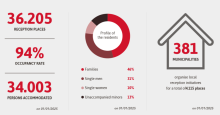
While Belgium continues to face a reception crisis, ongoing since the summer of 2021, the latest figures from Fedasil show that the number of places for asylum seekers made available by municipalities continues to decrease.
Theme:
Type:
Keywords:
05/01/2025
This ad hoc query examines how EMN Member and Observer Countries use service providers for return and reintegration services. It covers whether countries manage operations directly or rely on service providers, details on contracts and procurement methods used, and how they assess European Procurement Regulations when choosing procurement approaches, including any exceptions justifying direct contracts.
Theme:
Publication type:
Keywords:
03/01/2025
This ad hoc query looks into the time limit within which an administrative authority may detain, without judicial review, an applicant for international protection or an irregularly staying third-country national who is subject to return.
Theme:
Publication type:
Keywords:
21/12/2024
This ad hoc query explores the legal frameworks and practices of EMN Member Countries to understand how they link reception conditions to whether an asylum seeker is legally employed.
Theme:
Publication type:
Keywords:
05/12/2024
On the occasion of International Volunteer Day, Fedasil highlights the importance of volunteers who give their time to residents in reception centres and of sponsors who create links with these residents outside of the centres. If you have free time, join them and contact a reception centre in your neighbourhood!

18/10/2024
The 2024 national conference of EMN Finland shall examine the state of play as well as the future prospects of the situation of Ukrainians in Finland and in EU countries. The conference aims to address the challenges of integration in a situation where beneficiaries of temporary protection find themselves between two countries. The conference seeks to support these persons in the limbo between integration and return.

29/08/2024
The European Migration Network (EMN) Hungary Presidency High-Level Conference will focus on possible avenues for more effective and efficient implementation of returns, with special emphasis on the important aspects of the return procedure, internal coherence, and joint cooperation with third countries and digitalisation to support the common EU system for returns.

18/11/2024
The Federal Institute for Human Rights launched an investigation into "the growing tendency of Belgian authorities not to implement court decisions that condemn them", inter alia regarding the reception of applicants for international protection. The report following the investigation will be sent to the Chamber of Representatives.
12/11/2024
Fedasil announced that the Belgian reception network has now a higher capacity than that recorded during the asylum crisis of 2015-2016. However, this capacity is insufficient to accommodate all applicants for international protection who are entitled to reception. At present, 2.650 single men are still on the waiting list for a reception place.
04/11/2024
Fedasil announced that it can temporarily make use of centres in Bredene (Flanders) and in Theux (Wallonia) to accommodate applicants for international protection until March 2025. Both sites have already been used by Fedasil in the past, each time for a period of a few months.
01/11/2024
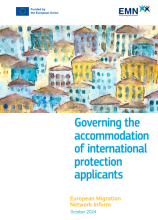
This inform provides insights into the governance and processes of accommodation for applicants for international protection in EMN Member and Observer Countries. This governance of accommodation is crucial for responding to challenges, such as fluctuating asylum applications, limited housing capacity, and community relations.
Theme:
Publication type:
Keywords:

29/10/2024
In its overview of national forced return monitoring systems across the EU in 2023, the EU Agency for Fundamental Rights (FRA) noted that only one EU Member State did not monitor its national forced return operations in 2023. It also highlighted persistent challenges that affect the transparency and effectiveness of monitoring operations.
10/10/2024
Fedasil has a budget for financing specific projects relating to the reception of asylum seekers (and other reception beneficiaries). The Agency has launched its call for projects for the year 2025. In 2025, the focus will be on projects that focus on support, activation, and housing.
Theme:
Type:
Keywords:

17/10/2024
In a recent judgment, the Court of Justice of the European Union found that an administrative authority which rejects an application for a residence permit based on national law and, consequently, finds that the third-country national concerned is staying illegally on the territory of the Member State in question, must ensure compliance with the principle of non-refoulement, by reviewing, in the light of that principle, the return decision previously adopted against that national in the context of a procedure for international protection.
Theme:
Type:
Keywords:

10/10/2024
A few days after 17 European countries called on the European Commission to submit a new legislative proposal for more effective returns, Justice and Home Affairs Ministers discussed the issue of return during a working lunch in Luxembourg. They tasked experts with starting to explore innovative ideas related to returns.