
Backed by Italy and Denmark, a group of nine EU Member States has issued a letter calling for a new interpretation of the European Convention on Human Rights (ECHR) to facilitate the expulsion of foreign nationals convicted of crimes. While the letter's authors frame it as a call for open discussion, the move has raised concerns over judicial independence and the protection of fundamental rights in Europe.
24/05/2025

22/05/2025
On 21 and 22 May 2025, the European Migration Network’s Return Experts Group (EMN REG) convened a two-day workshop, hosted by the Belgian Immigration Office and EMN Belgium. The event brought together 50 participants from EU Member States, EU agencies (including Frontex and the EU Asylum Agency), civil society organisations, and international organisations. The workshop focused on the development and implementation of effective alternatives to detention (ATDs) within the EU’s migration and return systems.
01/05/2025
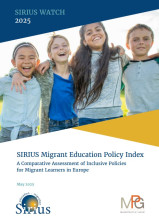
The 2025 SIRIUS Migrant Education Policy Index introduces a novel framework for evaluating inclusive education policies across 15 EU Member States. Structured around seven key dimensions, the Index highlights existing disparities and effective practices in supporting migrant learners. It underscores the urgent need for systemic reforms to ensure equitable and high-quality education for all students, regardless of migration background. The report advocates for a learner-centred approach prioritising structural flexibility, cultural and linguistic inclusion, and coordinated policy interventions.
Theme:
Publication type:
Keywords:

03/04/2025
This ad hoc query, launched by EMN Belgium, explores whether authorities in EMN Member Countries are permitted to search the electronic devices of irregularly staying third-country nationals in the context of return. It examines the legal conditions under which such searches may take place, the categories of individuals concerned, the availability of related statistics, and the perceived impact on identification processes. The query also invites information on challenges encountered and any planned legislative developments in this area.
Theme:
Publication type:
Keywords:

11/03/2025
The European Commission has released a proposal for a regulation establishing a common system for the return of third-country nationals staying illegally in the Union. The new rules introduce, among other things, stronger obligations for returnees and the legal possibility of returning individuals who are illegally staying in the EU and have received a final return decision to a return hub in a third country. The European Parliament and the Council of the EU must now examine and negotiate the proposal.
07/03/2025
This ad hoc query examines the voluntary return procedures for Ukrainian nationals granted temporary protection in EU Member States, focusing on the support provided for their return and reintegration. The aim is to understand the various national approaches to facilitating voluntary returns, including whether reintegration assistance is offered and how these programmes are funded.
Theme:
Publication type:
Keywords:

27/02/2025
In 2024, 1.261 detainees were forcibly returned from Belgian prisons, down from 1.428 in 2023 and 1.511 in 2022, according to the Immigration Office. The most represented nationalities among those returned were Albanians, Moroccans, and Algerians. This decline comes amid ongoing challenges linked to prison overcrowding and changes in early-release policies.
Theme:
Type:
Keywords:

14/02/2025
The Benelux countries and Suriname have agreed to facilitate the return of individuals in irregular situations from the Benelux or Suriname to their country of origin. Additionally, they have decided to grant visa-free travel for diplomats and government officials between the Benelux countries and Suriname.

06/02/2025
In a position paper published on 6 February 2024, the European Union Agency for Fundamental Rights (FRA) sets out the conditions that would have to be met for return hubs to respect fundamental rights and comply with EU law. This includes independent monitoring to reduce the risks of fundamental rights violations.
31/01/2025
In 2024, Belgium saw a notable increase in the number of individuals choosing voluntary return to their country of origin. According to Fedasil’s press release from 3 February 2024, the total number of individuals opting for voluntary return rose by 11% compared to the previous year.

27/01/2025
In a press release published on 27 January 2025, the Secretary of State for Asylum and Migration announced that Belgian authorities could organise the forced return of Afghans to Istanbul and that partners on the ground could then take them to Afghanistan. This collaboration and the budgets for it still need to be finalised by a new government.
05/01/2025
This ad hoc query examines how EMN Member and Observer Countries use service providers for return and reintegration services. It covers whether countries manage operations directly or rely on service providers, details on contracts and procurement methods used, and how they assess European Procurement Regulations when choosing procurement approaches, including any exceptions justifying direct contracts.
Theme:
Publication type:
Keywords:
03/01/2025
This ad hoc query looks into the time limit within which an administrative authority may detain, without judicial review, an applicant for international protection or an irregularly staying third-country national who is subject to return.
Theme:
Publication type:
Keywords:

18/10/2024
The 2024 national conference of EMN Finland shall examine the state of play as well as the future prospects of the situation of Ukrainians in Finland and in EU countries. The conference aims to address the challenges of integration in a situation where beneficiaries of temporary protection find themselves between two countries. The conference seeks to support these persons in the limbo between integration and return.

29/08/2024
The European Migration Network (EMN) Hungary Presidency High-Level Conference will focus on possible avenues for more effective and efficient implementation of returns, with special emphasis on the important aspects of the return procedure, internal coherence, and joint cooperation with third countries and digitalisation to support the common EU system for returns.

29/10/2024
In its overview of national forced return monitoring systems across the EU in 2023, the EU Agency for Fundamental Rights (FRA) noted that only one EU Member State did not monitor its national forced return operations in 2023. It also highlighted persistent challenges that affect the transparency and effectiveness of monitoring operations.

17/10/2024
In a recent judgment, the Court of Justice of the European Union found that an administrative authority which rejects an application for a residence permit based on national law and, consequently, finds that the third-country national concerned is staying illegally on the territory of the Member State in question, must ensure compliance with the principle of non-refoulement, by reviewing, in the light of that principle, the return decision previously adopted against that national in the context of a procedure for international protection.
Theme:
Type:
Keywords:

10/10/2024
A few days after 17 European countries called on the European Commission to submit a new legislative proposal for more effective returns, Justice and Home Affairs Ministers discussed the issue of return during a working lunch in Luxembourg. They tasked experts with starting to explore innovative ideas related to returns.

04/10/2024
In a non-paper, seventeen European countries called on the European Commission to submit a new proposal for more effective returns. The letter emphasises the need for a stricter EU return system with clearer obligations for cooperation from the returnees and less interpretation by the European Court of Justice.
06/09/2024
This Inform explores good practices and challenges in the coordination between different stakeholders and between different stages of return and reintegration of third-country nationals in EMN Member and Observer Countries. It explains how improved coordination among stakeholders, enhanced institutional frameworks, and effective national strategies can facilitate a consistent and structured approach to return and reintegration across Europe.
Theme:
Publication type:
Keywords:

02/09/2024
Students, who were originally from Syria and Congo before becoming refugees in Egypt and Uganda, have the opportunity to start this new academic year in Belgian universities thanks to the legal and sustainable migration pathway offered by the university corridors.
05/08/2024
This ad hoc query examines how various EU Member States have implemented Article 15 of the Return Directive (2008/115/EU), Article 8 of the Reception Conditions Directive (2013/33/EU), and Article 28 of the Dublin Regulation (EU 604/2013), all of which pertain to the detention of third-country nationals.

29/07/2024
In a judgement from 29 July 2024, the Court of Justice of the EU states that a Member State may reject an abusive application for an authorisation to reside on its territory for the purpose of study, even if it has not correctly transposed the directive that provides for that option.
Theme:
Type:
Keywords:
18/07/2024
This ad hoc query focuses on the implementation of Article 31(2) of Directive 2016/801, which sets out the conditions for notifying mobility of students between two or more EU Member States. The query examines the mobility notification process, existing arrangements in the absence of an official notification process, and the rules applicable to students covered by an EU programme, a multilateral programme involving mobility measures or an agreement between two or more higher education institutions, as opposed to those applicable to students who are not.
Theme:
Publication type:
Keywords:
03/07/2024
This ad hoc query examines which alternatives to detention are most commonly used, especially for families with children, and how the effectiveness of the alternatives to detention is assessed. It further analyses which elements (indicators, statements, etc.) are taken into account before imposing an alternative to detention and what challenges are faced in this matter.