Publication date:
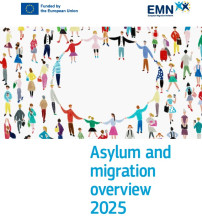
On 20 July 2026, the European Migration Network (EMN) launched the European Asylum and Migration Overview 2025 during an online launch event. The annual publication provides an overview of the main asylum and migration developments across 30 EMN Member and Observer Countries. Based on national contributions from these countries, the publication presents a synthesis of key policy, legislative and operational developments in asylum and migration across Europe in 2025. It is accompanied by a Statistical Annex containing relevant European and national data.
Read more
Main theme: Cross-sectional, Asylum, Migration
Keywords: EMN, Asylum and Migration Overview, launch

Publication date:
Belgium’s Minister for Asylum and Migration, Anneleen Van Bossuyt, has announced a further reduction of 700 reception places provided under the Brussels Deal. This follows an earlier reduction of around 300 places announced at the end of June. According to the Minister, the measure reflects a decrease in the need for additional reception capacity for applicants for international protection awaiting access to the Fedasil reception network.
Read more
Main theme: Reception
Keywords: Brussels Deal, reception place, reduction

Publication date:
The European Union agencies Europol and Frontex have signed a new Working Arrangement to strengthen their cooperation in addressing cross-border threats affecting the European Union. The agreement replaces the 2015 arrangement and takes into account the expanded mandates of both agencies, providing an updated framework for the secure exchange of information, including for operational purposes.
Read more
Main theme: Borders & Visa, Smuggling & Trafficking
Keywords: Europol, European Border and Coast Guard, working arrangement
Publication date:
Myria, the Federal Migration Centre, has provided information on the possibilities for people in Gaza to travel to Belgium, focusing on two issues: the possibility of submitting a visa application from the Gaza Strip and the possibility of being evacuated to Belgium. While remote submission is currently possible for certain family reunification visa applications, other visa applications cannot currently be submitted remotely. Myria also reports that there are currently no evacuations from Gaza to Belgium and no apparent prospect of a new government decision to resume them.
Read more
Main theme: Borders & Visa
Keywords: Gaza, visa application, evacuation, Belgium
Publication date:
EU Member States have agreed to extend temporary protection for people fleeing Russia's war of aggression against Ukraine until 4 March 2028. The decision also introduces new eligibility conditions for future applicants, linking access to temporary protection to compliance with military obligations under Ukrainian law. The new rules will apply only to new applicants and will not affect people already benefiting from temporary protection in the EU.
Read more
Main theme: Temporary protection
Keywords: Temporary Protection Directive, extension, military obligation
Publication date:
The European Commission and the High Representative of the Union for Foreign Affairs and Security Policy have proposed a new horizontal EU sanctions regime targeting migrant smuggling, trafficking in human beings and other serious forms of organised crime. The proposed framework would allow the European Union to impose restrictive measures on individuals and entities involved in such activities originating outside the EU where they pose a serious threat to the Union's values, the security of the EU and its Member States, or to international security. The proposals will now be examined by the Council.
Read more
Main theme: Smuggling & Trafficking
Keywords: migrant smuggling, trafficking in human beings, sanction, asset freeze, travel ban
Publication date:
The Belgian Council of State has suspended the decision of the Minister of Asylum and Migration to limit material reception conditions for applicants for international protection who have already obtained protection in another EU Member State. In its judgment No. 267.364 of 8 July 2026, the Council of State suspended the measure following an urgent appeal introduced by several organisations active in the field of asylum and migration. The decision concerns a measure adopted following the entry into application of the European Pact on Migration and Asylum on 12 June 2026.
Read more
Main theme: Reception
Keywords: applicant for international protection, material reception condition, limitation, Council of State, suspension
Publication date:
The European Commission has rejected calls from the aviation sector and the Port of Dover to suspend the EU Entry/Exit System (EES) during the summer travel season. While acknowledging operational difficulties at around 20 external border crossing points, the Commission considers that suspending the system would not be appropriate. It has instead announced additional efforts to support Member States facing implementation challenges.
Read more
Main theme: Borders & Visa
Keywords: entry exit system, implementation, suspension

Publication date:
The Minister of Asylum and Migration, the Belgian Immigration Office and the municipality of Nazareth-De Pinte have announced the opening of a new European Return Centre in Nazareth-De Pinte in autumn 2026. The centre will have a capacity of 300 places and will accommodate applicants for international protection for whom another EU Member State may be responsible for examining their application. The facility will complement the existing Centre in Zaventem and aims to support procedures related to transfers to the responsible Member State.
Read more
Main theme: International Protection
Keywords: applicant for international protection, Dublin Regulation, Dublin transfer, return centre

Publication date:
This conference will explore European and Dutch experiences in supporting the early integration of applicants for international protection, with a particular focus on employment, language learning and cultural orientation. Drawing on the findings of a new EMN Inform, the event will bring together policymakers, experts and practitioners to discuss different national approaches, implementation challenges and good practices across Europe.
Read more
Main theme: Integration
Keywords: applicant for international protection, early integration, employment, language learning, cultural orientation

Publication date:
For the next six months, Ireland will hold the Presidency of the Council of the European Union. From 1 July to 31 December 2026, Ireland will chair the work of the Council and steer negotiations across a wide range of policy areas, including justice and home affairs. In the field of asylum and migration, the Irish Presidency has placed particular emphasis on implementing the Pact on Migration and Asylum, strengthening returns, and enhancing cooperation with partner countries.
Read more
Main theme: Cross-sectional, Asylum, Migration
Keywords: Irish Presidency, Council of the European Union
Publication date:
The new Directive on the rights, support and protection of victims of crime revises the EU framework on the rights of people who are victims of criminal offences, including victims of violence, victims of trafficking in human beings, child victims of sexual exploitation, and victims of terrorism. It introduces measures to improve access to information, support and protection, facilitate the reporting of crime and strengthen victims’ rights in criminal proceedings.
Read more
Main theme: Smuggling & Trafficking
Keywords: victim of trafficking, victim of crime, access to rights, Victims' Rights Directive

Publication date:
The City of Tournai has adopted a common protocol to guide the dismantling of informal migrant camps, with the aim of ensuring coordinated interventions while safeguarding the dignity and fundamental rights of the persons concerned. The protocol was developed jointly by local authorities, police and civil society organisations following discussions prompted by previous dismantling operations.
Read more
Main theme: Irregular Migration
Keywords: migrant camp, dismantling, cooperation, fundamental rights

Publication date:
EMN Luxembourg and the Luxembourg Ombudsman for Children and Youngsters (OKaJu) are bringing together EU ombudsmen for children and youth, as well as child welfare agencies, to discuss the best interests of the child in the context of the implementation of the EU Pact on Migration and Asylum. The meeting offers a timely opportunity to take stock of early experiences and emerging practices. It places a particular focus on ensuring that fundamental rights obligations, especially those relating to children, are upheld in national systems.
Read more
Main theme: Vulnerable groups
Keywords: New Pact on Migration and Asylum, best interests of the child, fundamental right

Publication date:
During this launch event, participants will gain a better understanding of key developments in migration and asylum across EMN Member and Observer Countries in 2025. Based on the findings of the EMN Asylum and Migration Overview (AMO) 2025, the event will present the main trends and policy developments identified at both EU and national levels.
Read more
Main theme: Cross-sectional, Asylum, Migration
Keywords: Asylum and Migration Overview, asylum trend, migration trend, annual report
Publication date:
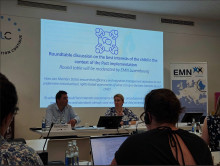
On 25 June 2026, the Belgian Contact Point to the European Migration Network (EMN) participated in the third thematic meeting on children in migration, organised jointly by the Luxembourgish Contact Point to the EMN and the OKaJu (Ombudsman for Children in Luxembourg – Ombudsman fir Kanner a Jugenlecher). The aim of the conference was to discuss the best interests of the child in the context of the implementation of the EU Pact on Migration and Asylum. The event brought together various stakeholders from 24 countries, as well as several international organisations and networks, both online and in person.
Read more
Main theme: Vulnerable groups
Keywords: migrant child, best interests of the child, New Pact on Migration and Asylum, implementation
Publication date:
According to figures published by Statbel on 10 June 2026, 69.017 persons acquired Belgian nationality in 2025. The most common previous nationalities among those who became Belgian were Moroccan, Romanian, Syrian, Polish and Italian. Compared to 2024, the number of acquisitions of Belgian nationality increased by almost 9.000.
Read more
Main theme: Citizenship & Nationality
Keywords: Belgian nationality, access to nationality

Publication date:
The United Kingdom has officially joined the European Migration Network (EMN) as an Observer Country. An Administrative Arrangement was signed on 19 June between the European Commission and the UK Home Office, formalising cooperation within the EMN framework. The agreement reinforces the exchange of objective and comparable information on migration and asylum and marks an important step in strengthening cooperation between the United Kingdom and the EMN.
Read more
Main theme: Cross-sectional, Asylum, Migration
Keywords: European Migration Network, observer country, United Kingdom

Publication date:
Belgium has taken up its role as Co-Chair of the EMN Return Expert Group (REG), together with the European Commission. In this capacity, EMN Belgium hosted a plenary meeting of the REG on 16 June 2026 in Brussels.
Read more
Main theme: Return & Readmission
Keywords: EMN, REG, return expert group

Publication date:
A draft law introducing the possibility of home searches to enforce return decisions has begun its parliamentary examination in the House of Representatives. The measure would concern certain third-country nationals subject to an enforceable return decision who do not cooperate with their return and are considered to pose a risk to public order or national security. Discussed by the Committee on Home Affairs on 16 June 2026, the proposal will be subject to consultations with experts and stakeholders before the committee continues its examination.
Read more

Publication date:
Belgium has contributed to Operation Global Chain 2026, a large-scale international law enforcement operation targeting human trafficking networks. Coordinated across 59 countries, the operation took place from 8 to 12 June 2026 and focused on trafficking for sexual exploitation, forced criminality and forced begging, with a particular focus on underage victims. In Belgium, a police operation in Charleroi and Verviers led to the dismantling of a trafficking network and the identification of 22 minor victims.
Read more
Main theme: Smuggling & Trafficking
Keywords: human trafficking, Operation Global Chain, sexual exploitation, forced criminality, forced begging, underage victim
Publication date:
The European Union Agency for Asylum (EUAA) has published its Asylum Report 2026, providing an overview of asylum-related developments across EU+ countries in 2025 and early 2026. The report examines key policy, legislative and operational changes in the field of asylum against a backdrop of ongoing conflicts and geopolitical developments. It also analyses how EU+ countries prepared for the implementation of the Pact on Migration and Asylum.
Read more
Main theme: Asylum
Keywords: asylum applications, asylum decisions, asylum trend
Publication date:
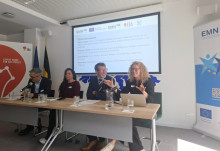
On 4 June 2026, EMN Belgium and EMN Sweden, together with the Swedish Expert Group for Aid Studies (EBA) and the Swedish Migration Studies Delegation (Delmi), organised the EU launch seminar “Linking Migration and Development Cooperation: European Experiences and Policy Reflections” at the Permanent Representation of Belgium to the EU in Brussels.
Read more

Publication date:
On 26 May 2026, EMN Belgium gathered over 130 key stakeholders in the fields of asylum and migration. This event also marked the launch of the Belgian Asylum and Migration Overview 2025, which highlights the principal developments in asylum and migration in Belgium over the previous year. The diverse audience of experts engaged in reflection and discussion on recent trends in the field, as well as on strengthened cooperation within the Belgian asylum and migration system. The day also included breakout session on key topics, alongside informal networking to build connections and inspire new collaborations.
Read more
Main theme: Cross-sectional, Asylum, Migration
Keywords: annual EMN policy event
Publication date:
Belgium has adopted new rules governing the renewal of residence permits for third-country national students. The amendments introduce stricter requirements concerning study progress, maximum study duration, changes of study programme and enrolment in non-recognised higher education institutions. They were adopted by Royal Decree of 7 May 2026, published in the Belgian Official Gazette on 21 May 2026, and apply from the 2026/2027 academic year.