This conference will explore European and Dutch experiences in supporting the early integration of applicants for international protection, with a particular focus on employment, language learning and cultural orientation. Drawing on the findings of a new EMN Inform, the event will bring together policymakers, experts and practitioners to discuss different national approaches, implementation challenges and good practices across Europe.

07/05/2026
The Court of Justice of the European Union has ruled on the compatibility of a national residence requirement with EU equal treatment rules. The Court examined whether a 10-year residence condition could be applied to beneficiaries of international protection in order to access a social benefit. It found that the measure constitutes indirect discrimination prohibited under EU law.

07/05/2026
DUO for a JOB has launched a national awareness campaign highlighting the persistence of discrimination in recruitment processes in Belgium. The initiative uses the format of the well-known game “Guess Who?” to illustrate how candidates may still be excluded on the basis of appearance, name, origin or accent rather than skills. The campaign is being rolled out in May across public spaces, including stations and metro networks in several Belgian cities.
20/03/2026
On 20 March 2026, the Belgian Council of Ministers approved a draft law that would link the level of social assistance granted to beneficiaries of subsidiary and temporary protection to their participation in integration efforts through the Individual Social Integration Project (ISIP). Under the proposal, the amount of social assistance could be adjusted depending on the efforts made by the beneficiary to integrate.
19/03/2026
This ad hoc query inquires about the differences in access to social assistance benefits for refugees, beneficiaries of subsidiary protection and beneficiaries of temporary protection in EMN Member Countries. Additionally, it looks at the reasons given for these differences in access to social assistance benefits and considers whether there are any plans or proposals to introduce further distinctions in access for these groups in the near future.
Theme:
Publication type:
Keywords:
12/03/2026
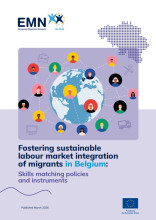
This study examines skills matching for migrants in Belgium as part of a broader European-level analysis conducted within the framework of the EMN. It focuses on how policies and initiatives align migrants’ qualifications and skills with labour market needs. The analysis considers both vertical and horizontal mismatches, where skills or fields of study do not correspond to job requirements. It identifies key challenges, as well as lessons learned and good practices, in supporting sustainable labour market integration through improved skills matching.
Theme:
Publication type:
Keywords:
01/01/2026
From 1 January 2026, the Onder1Dak project, which promotes co-housing between private homeowners and recognised refugees in Flanders, has restarted following renewed support from the Flemish Minister for Civic Integration and Integration. The initiative aims to facilitate access to housing while supporting the social and professional integration of recognised refugees.

12/12/2018
On 12 December 2018, the Belgian contact point of the EMN organized its annual asylum and migration policy event in which recent national and EU developments in the field of international protection, legal migration and integration and irregular migration, human trafficking and return were discussed.
Theme:
Type:
Keywords:

01/06/2018
The results of the third sociomonitoring report, published in December 2017, will be presented by the Federal Public Service Employment and Unia, in order to better understand the situation of persons on the labour market according to their origin.
16/05/2018
One of the greatest challenges facing twenty-first century Europe is the mass migration and integration of refugees who cross borders in search of safer lives. This report of the European Foundation for Democracy analyses the wide-ranging issues relating to the integration of refugees in seven European countries, including Belgium) and presents our key findings – both in terms of good practices and areas for concern – as well as recommendations for change.

03/05/2018
The panel discussion will present the findings of the recently completed research project of the European Foundation for Democracy which examined how different European countries with high numbers of refugees and/or experience of integrating high numbers of refugees are managing the integration process and identifies good practices for integrating refugees. The research looked in particular at the situation of Syrian refugees in Europe, though not exclusively.

01/02/2018
This updated report assesses how the presence of persons in need of protection affect the local communities in terms of housing, education, local economy and social responses
10/01/2018
The third socioeconomic monitoring includes data from 2013-2014, enlarges the analyzed age group and includes new variables - such as the level of education - and themes - such as the public sector - to better understand participation in the labour market according to the origin.
Theme:
Publication type:

01/01/2018
As of 1 January 2018, certain third-country nationals have the obligation to follow an integration programme in the German-speaking Community.