The number of irregular border crossings into the European Union in the first six months of 2024 fell to roughly 94.000, according to preliminary data collected by Frontex. The Western Balkans and the Central Mediterranean recorded the largest decreases in detections of irregular border crossings, while the West African and the Eastern Land Border have seen the largest increases.
01/07/2024
From 1 July 2024, adult asylum seekers who stay in a reception centre and who have a working income will have to contribute to this reception. Those who do not wish to contribute may consider staying outside the reception centre. They are free to leave the centre and find their own accommodation.
Theme:
Type:
Keywords:
07/06/2024
This online annual conference, organised by the Academy of European Law (ERA), will debate the latest developments and challenges in the EU’s internal and external border management. It will inter alia analyse the latest proposals and reforms on the functioning and operation of EU border management systems, including Schengen, as well as Frontex’ role and responsibilities.
Theme:
Type:
Keywords:
27/06/2024
In order to structurally shorten the duration of reception in Belgium, an amendment was made to the Reception Act. Anyone who receives a final negative asylum decision must leave the reception place within a period of 30 days.
21/06/2024
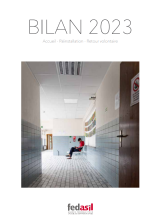
In its 2023 Annual Report, Fedasil reviews the key events of the year and provides an overview of the reception network for international protection applicants, the resettlement of refugees, and voluntary returns. The report also presents key statistics that offer valuable insights into these areas, helping to illustrate both the challenges faced and the progress made.
Theme:
Publication type:
Keywords:
05/06/2024
Doctors Without Borders, Doctors of the World, CIRÉ, Vluchtelingenwerk Vlaanderen, BelRefugees, Caritas International, and the Humanitarian Hub underline the permanent lack of reception, protection and access to medical services for applicants for international protection without a reception place. They want to challenge policy-makers and raise public awareness about people left left on the street.
24/05/2024
On 24 May 2024, the Council of the European Union, with Spain and Slovenia abstaining, finally adopted the reform of the Schengen Borders Code. The reform inter alia aims to make the Schengen area more resilient to present and future crises at its external borders.

23/05/2024
In its 2023 annual report, the Federal Institute for Human Rights draws attention, among other things, to the failure of the authorities to enforce the rulings of the Belgian and European courts and tribunals, in particular in the context of the reception crisis. The lack of resources for the judiciary, threats to human rights defenders and weaknesses in the right to information are also underlined.

22/05/2024
On 22 May 2024, a joint conference hosted by Fedasil and the EUAA highlighted innovative collaboration models designed to strengthen migration systems. The event brought together diverse participants from various EU Member States, including government bodies, international organisations, civil society groups, and private entities. It focused on strategies to improve the reception, information provision, and pre-integration of international protection applicants.
16/05/2024
The Expert Conference, that is jointly hosted by Belgium’s Federal Agency for the Reception of Asylum Seekers (Fedasil), and the European Union Agency for Asylum (EUAA), in cooperation with the Migration Policy Institute Europe (MPI Europe), aims to explore multi-stakeholder strategies in three specific areas: reception, information provision, and pre-integration.
Theme:
Type:
Keywords:
03/05/2024
On Friday 3 May 2024, the Council of Ministers approved a draft royal decree appointing Pieter Spinnewijn as Director General of the Federal Agency for the Reception of Asylum Seekers (Fedasil). His mandate will begin on 1 July 2024 for a period of six years.
03/05/2024
This ad hoc query seeks to better understand EMN Member and Observer Countries’ approaches to financial contributions in the context of reception for international protection applicants.
Theme:
Publication type:
Keywords:

02/05/2024
On 2 May 2024, the Chamber of Representatives adopted in plenary session the draft law relating to the competencies of the members of the European Border and Coast Guard Agency on the national territory. The law inter alia defines how Frontex members will support the Federal Police in the field of border controls and forced return of foreigners.
Theme:
Type:
Keywords:
16/04/2024
On 16 April 2024, the Commission published its 2024 State of Schengen report. The report elaborates on major legislative and policy developments in the area of Schengen from the past year, including the Pact on Migration and Asylum. It also reflects on challenges and sheds light on future priorities for the EU in the field of Schengen.
Theme:
Type:
Keywords:

31/03/2024
On 31 March 2024, Bulgaria and Romania become Schengen members: the Schengen rules will apply in both Member States including on issuing Schengen visas and controls at the internal air and sea borders will be lifted. Discussions on a date for a possible lifting of the checks on persons at internal land borders will continue in 2024.

28/03/2024
On 28 March 2024, the House of Representatives, during the plenary session, approved by a majority the ETIAS law which establishes the Belgian ETIAS National Unit and defines its organisation and functioning. It will enforce the ETIAS (European Travel Information and Authorisation System) regulation adopted by the European Union in 2018.
Theme:
Type:
Keywords:
13/03/2024
At a meeting of the Council’s Permanent Representatives Committee (COREPER), Member States agreed their position on a draft regulation which updates a mechanism that allows the EU to suspend visa-free travel for third countries whose nationals are exempt from the visa obligation when travelling to the Schengen area.

01/03/2024
Today, the Belgian Presidency of the Council and European Parliament negotiators have provisionally agreed on two regulations that govern the collection and use of air passenger data for border management and law enforcement.

28/02/2024
On 28 February 2024 the European Ombudsman published a press release regarding the completion of its inquiry about the Adriana shipwreck in June 2023, which also included recommendations regarding broader systemic issues. The Ombudsman called on EU legislators to address fundamental rights gaps and to establish an independent commission of inquiry to assess the reasons for the large numbers of deaths in the Mediterranean.
Theme:
Type:
Keywords:
15/02/2024
Given the strong pressure on the Belgian reception system, Fedasil created more than 3.000 places in 2023. Despite these efforts, Fedasil ran out of places to accommodate all applicants for international protection last year.
13/02/2024
In its pushback report 2023 published today, the human rights organisation 11.11.11. says there were 346.004 illegal pushbacks of people migrating to Europe in 2023 - that is 947 every day. The organisation used information provided by NGOs, human rights bodies and UN agencies to report this figure.

09/02/2024
On the proposal of the Secretary of State for Asylum and Migration, the Council of Ministers agreed today to the conclusion of a rental contract for land in Lodelinsart (Charleroi). Fedasil will make the site available to the Belgian Red Cross to place containers in order to increase the reception capacity for applicants for international protection.
06/02/2024
The Belgian presidency of the Council of the EU and European Parliament negotiators today reached a provisional deal on amending the Schengen Borders Code. The update in particular clears up rules related to the reintroduction of border controls and offers solutions to situations where migrants are instrumentalised.
Theme:
Type:
Keywords:
25/01/2024
A new reception centre that can accommodate a maximum of 135 applicants for international protection has opened in Ghent. This is the second reception centre managed by Fedasil in the city. Since 2020, the Agency has been organizing the reception of 250 people on a pontoon in the port of Ghent.
01/01/2024
As of today, 1 January 2024, the people of Kosovo with biometric passports no longer require visas when travelling for short stays of up to 90 days in any 180-day period to all 27 Schengen Area countries.