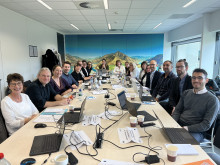
The Glossary Working Group meets regularly to maintain the EMN Asylum and Migration Glossary up to date. This 62nd meeting, hosted by EMN Belgium, was an opportunity to discuss cooperation with partners, especially in preparation of the inclusion of new terms related to the Pact on Migration and Asylum.
Main Theme: Cross-sectional
Keywords: glossary, New Pact on Migration and Asylum
In a letter to the 27 EU Member States, Ursula von der Leyen announced that the Commission will present a new proposal for legislation to ensure solid rules for the removal of irregularly staying third-country nationals, including those posing a threat to public order or internal security. She also referred to possible "return hubs" outside the EU, drawing lessons from the start of operations of the Italy-Albania protocol.
Main Theme: Cross-sectional
Keywords: efficient return, return hub, mutual recognition of return decisions, security
On 17 September 2023, the President-elect of the European Commission, Ursula von der Leyen, unveiled the names of Commissioners-designate for 2024-2029. The current Austrian Finance Minister, Magnus Brunner will be in charge of Internal Affairs and Migration, if he successfully passes the test of European Parliament hearings.
Main Theme: Cross-sectional
Keywords: Commissioner on Migration and Home Affairs
As of 1 August 2024, the European Commission will support nine Member States, including Belgium, in preparing their National Implementation Plans for the Pact on Migration and Asylum. These countries will receive targeted support to carry out situational analysis and identify the necessary actions to implement the Pact in line with the Common Implementation Plan.
In a press release from 26 July 2024, Myria, the Federal Migration Centre, calls on the authorities, given the scale of the humanitarian catastrophe in Gaza, to make greater efforts in terms of information provision and administrative and procedural flexibility, both in terms of access to evacuation and the submission and processing of visa applications.
Main Theme: Cross-sectional
Keywords: short-stay visa, long-stay visa, family reunification, Gaza
With 401 votes in favour, 284 against, and 22 cast blank or invalid votes, the European Parliament elected Ursula von der Leyen as President of the European Commission on 18 July. She presented her Political Guidelines for the next European Commission 2024-2029, referring inter alia to security, external borders, and migration management.
Main Theme: Cross-sectional
Keywords: European Commission, President, Europol, Frontex, European Border and Coast Guard, New Pact on Migration and Asylum

During a webinar followed by around 160 participants, the European Migration Network (EMN) and Eurostat launched the Annual Report on Migration and Asylum for 2023 and the accompanying Statistical Annex. Key highlights from the report were outlined as well as key figures to support policy-making and monitoring. National perspectives were also shared by Finland and Serbia.
Main Theme: Cross-sectional
Keywords: annual report

On 25 and 26 June 2024, EMN Belgium and its partners organised a high-level conference to present the Pact and outline subsequent steps for its implementation. The event, which convened 400 representatives from pivotal institutions and organisations, highlighted the opportunities and challenges associated with the Pact as well as the need and potential for partnerships in effectively implementing it.
During the last Justice and Home Affairs Council under the Belgian Presidency, Ministers agreed to extend the temporary protection for Ukrainians for one year. This will run until March 2026.
Main Theme: Cross-sectional, Asylum, Migration
Keywords: temporary protection, Ukraine, visa policy, Schengen, border control, interoperability
On 12 June 2024, the European Commission adopted the Common Implementation Plan which sets out the key milestones for all Member States to put in place the legal and operational capabilities required to successfully start applying the New Pact on Migration and Asylum by mid-2026. It provides a template for the National Implementation Plans to be adopted by Member States by the end of this year.
Main Theme: Cross-sectional
Keywords: New Pact on Migration and Asylum, common implementation plan
According to the 2024 Global Trends Report from UNHCR, one in every 69 people, or 1.5 % of the entire world’s population, is now forcibly displaced. The rise in overall forced displacement was the 12th consecutive annual increase and reflects both new and mutating conflicts and a failure to resolve long-standing crises.
Main Theme: Cross-sectional
Keywords: forced displacement, conflict, internally displaced person, refugee, stateless persons, return, resettlement, citizenship
On 23 May 2024, the Commission and representatives of non-governmental organisations (NGOs) and civil society discussed the implementation of the New Pact on Migration and Asylum. NGOs asked the Commission to encourage EU countries to work with civil society. They also shared concerns on the border procedure and respect of fundamental rights, and underlined the need for resources.
Main Theme: Cross-sectional
Keywords: New Pact on Migration and Asylum, implementation, non-governmental organisation, civil society, fundamental rights
On 14 May 2024, the Council of the European Union adopted 10 legislative acts which reform the entire European framework for asylum and migration management. Member States will now have two years to put the laws that were adopted today into practice. The European Commission will soon present a common implementation plan to provide assistance to Member States in this process.
Main Theme: Cross-sectional
Keywords: New Pact on Migration and Asylum

The Belgian Presidency of the EU Council organised a Ministerial Conference to work towards a common understanding of the main stages of the implementation of the Pact. Particular attention was paid to the development of common and national implementation plans, the role of EU agencies and key stakeholders, as well as good practices from EU countries.
Main Theme: Cross-sectional
Keywords: New Pact on Migration and Asylum, implementation, operationalisation

Under the framework of the Belgian Presidency of the Council of the European Union, EMN Belgium, together with its partners, organise a high-level conference on 25-26 June 2024 to discuss the operationalisation and implementation of the New Pact on Migration and Asylum. If you wish to join us in Brussels or online, make sure to register now!
Main Theme: Cross-sectional
Keywords: Belgian Presidency, New Pact on Migration and Asylum

During its annual policy event, the Belgian Contact Point of the European Migration Network (EMN) invited experts in the field of asylum and migration in Belgium to reflect on developments in 2023 and prospects for 2024. Subgroups examined in more detail measures in response to the reception crisis, the new right of residence for stateless persons, information campaigns in third countries, one-stop desk models for information provision, ongoing challenges and projects in the CGRS, Belgium’s talent mobility projects and emerging trends in the field of labour migration.
Main Theme: Cross-sectional
Keywords: annual EMN policy event

On 10 April 2024, the European Parliament narrowly approved ten legislative texts to reform the European migration and asylum policy. The so-called New Pact on Migration and Asylum now only needs the final green light from Member States, which is expected at the end of the month.
Main Theme: Cross-sectional
Keywords: New Pact on Migration and Asylum

The House of Representatives approved a draft law creating a prevention mechanism to safeguard the rights of people detained in prisons, closed centres and police stations. The mechanism will be overseen by the Federal Institute for Human Rights, in conjunction with the Central Prison Monitoring Council, the Federal Migration Centre Myria, and 'Committee P'.
Main Theme: Cross-sectional
Keywords: prison, closed centre, monitoring, torture

During the European Council on 21-22 March 2024, EU leaders reviewed the state of play on migration following the Communication from the Commission and reaffirmed the EU’s commitment to continue pursuing a comprehensive approach to migration as agreed in its conclusions of December 2023.
Main Theme: Cross-sectional
Keywords: New Pact on Migration and Asylum, Council of the European Union
Commissioner for Home Affairs, Ylva Johansson together with the Mauritanian Minister of Interior and Decentralisation, Mohamed Ahmed Ould Mohamed Lemine, have signed a Joint Declaration launching an EU-Mauritania migration partnership. Both parties will hold a dialogue on a regular basis to implement this Joint Declaration.
Main Theme: Cross-sectional
Keywords: migration dialogue, Migration Partnership
Today, the European Parliament’s Committee on Civil Liberties, Justice, and Home Affairs (LIBE) approved the inter-institutional agreement achieved in December with the Council on the Migration and Asylum Pact.
Main Theme: Cross-sectional
Keywords: New Pact on Migration and Asylum
Today, EU Member States’ representatives meeting in the Coreper approved key laws which will reform the EU’s asylum and migration system. The EU laws of the Pact touch upon all stages of asylum and migration management.
Main Theme: Cross-sectional
Keywords: New Pact on Migration and Asylum

EU Home Affairs Ministers met today in Brussels during an informal meeting. Emphasis was placed on the need to finalize the legal texts of the New Pact on Migration and Asylum and to start the implementation process. Ministers also discussed the future of Ukrainian beneficiaries of temporary protection in Europe.
Main Theme: Cross-sectional, Asylum, Migration
Keywords: Belgian Presidency, Council of the European Union, Ukraine, temporary protection, New Pact on Migration and Asylum

Today the Secretary of State for Asylum and Migration, in the presence of all relevant asylum and immigration services, presented the new migration code. This new code aims to clarify procedures, simplify the texts and better fight against abuse.
Main Theme: Cross-sectional
Keywords: Migration Code, immigration law, reception law
The International Organization for Migration (IOM) looks forward to cooperating with the Belgian and Hungarian Presidencies of the Council of the European Union and stands ready to offer its continued support and expertise. With a view to building this partnership, the IOM publishes some recommendations on migration and mobility for 2024.