
Publication date:
The EMN Spain Conference marks the 40th anniversary of Spain’s accession to the EU and reflects on four decades of transformation in migration policy and integration. It will explore Spain’s journey from a country of emigration to a key destination for migrants, alongside the evolving EU migration framework. The event highlights the Schengen Agreement’s role and the new European Pact on Migration and Asylum. Policymakers and experts will discuss challenges and opportunities shaping the future of migration in Europe.
Read more
Main theme: Cross-sectional, Asylum, Migration
Keywords: Spain, accession to the EU, Schengen Agreement, New Pact on Migration and Asylum

Publication date:
The EMN Italy National Conference 2025 focuses on the implementation of the European Pact on Migration and Asylum. Organised by the Central Directorate for Migration Policies within the Italian Ministry of the Interior, the event highlights the role of coordinated multi-level governance involving European, national, regional, and local actors. The conference aims to explore policy developments, governance structures, and practical experiences related to migration and asylum management in Italy and across the EU.
Read more
Main theme: Cross-sectional, Asylum, Migration
Keywords: New Pact on Migration and Asylum, multilevel governance, regional actor, local actor
Publication date:
On 30 September 2025, seven organisations, including humanitarian groups, published the fifth edition of their Belgian report on the country’s non-reception policy and its effects on asylum seekers. The report provides data on reduced access to accommodation and essential services during the first half of 2025, following policy changes introduced by the coalition government formed in January. It documents impacts on housing, healthcare, mental health, and legal support for people seeking international protection.
Read more
Main theme: Reception
Keywords: reception crisis, reception capacity

Publication date:
On 30 September 2025, at the invitation of Enabel, EMN Belgium had the opportunity to present the specific features of its network-based approach to representatives from Côte d’Ivoire and Mauritania, who visited Belgium as part of an exchange visit focused on inclusion and (re)integration.
Read more
Main theme: Cross-sectional, Asylum, Migration
Keywords: EMN Belgium, network
Publication date:
The Fedasil Info Point in Brussels has been supporting asylum seekers and other migrants for two years, providing accessible and centralised information in one location. Since reopening on 27 September 2023 at the former Bordet Hospital site, it has welcomed over 22.000 visitors, mostly single men with ongoing asylum procedures. Visitors most frequently ask about accommodation, medical care, legal support, and other practical matters. Partners such as Caritas International and the European Union Agency for Asylum (EUAA) assist in providing guidance and support.
Read more

Publication date:
The Committee of Ministers of the Council of Europe examined the execution of the European Court of Human Rights judgment in Camara v. Belgium. The case highlighted a systemic failure to enforce judicial decisions ordering the State to provide accommodation and material support to asylum-seekers. While some progress has been made in freeing up reception places and improving operational support, concerns persist over reductions in capacity and the risk to the rule of law. The Committee urged the Belgian authorities to adopt sustainable measures and provide detailed information on enforcement.
Read more
Main theme: Reception
Keywords: reception crisis, Camara, reception place, rule of law, reception network
Publication date:
The Council of the European Union has adopted a recommendation outlining a common framework for the gradual transition of displaced Ukrainians out of temporary protection. The measures aim to support sustainable return and reintegration in Ukraine when conditions allow, while also facilitating access to other residence statuses for those eligible. The recommendation provides guidance on voluntary return, reintegration support and information systems for displaced persons.
Read more
Main theme: Temporary protection, Return & Readmission
Keywords: displaced person, Ukraine, residence permit, voluntary return, reintegration

Publication date:
The Directorate-General for Foreign Nationals in France of the Ministry of the Interior, together with EMN France and EMN Luxembourg, organise the 4th Workshop on Forecasting and New Technologies in Migration and Asylum Governance. It will gather representatives of EU agencies, international organisations, national authorities and academia. Participants will exchange on current practices, new developments and future directions in this field.
Read more
Main theme: Cross-sectional, Asylum, Migration
Keywords: forecasting, new technology, migration management, digitalisation, artificial intelligence

Publication date:
Eurostat data show that in 2024, the EU issued 3.5 million first residence permits to non-EU citizens, marking an 8.3% decrease compared with 2023, which had recorded the highest number to date. Employment remained the main reason for granting residence permits, while student permits continued to increase slightly.
Read more
Main theme: Data & Statistics, Asylum, Migration
Keywords: Eurostat, first residence permit

Publication date:
Myria is hiring a full-time Policy Officer (2-year contract) to support the Belgian Contact Point of the European Migration Network (EMN). The role focuses on economic migration and family reunification. You will contribute to English-language reports, studies, and EU-level policy work. The position is based in Brussels, with Myria as the employer.
Read more
Main theme: Cross-sectional, Asylum, Migration
Keywords: EMN Belgium, recruitment
Publication date:
Asylum applications in EU+ countries fell by nearly a quarter in the first half of 2025, according to the European Union Agency for Asylum (EUAA). A sharp decline in requests from Syrians, following political change in the country, shifted the profile of applicants across Europe. Venezuelans became the largest group seeking protection, while Germany lost its position as the main destination country. Recognition rates reached a record low, reflecting procedural factors and changes in applicant composition.
Read more
Publication date:
From 1 September 2025, the filing fee for appeals before Belgium’s Council for Alien Law Litigation will increase from €186 to €251, marking a rise of approximately 35%. The fee for parties wishing to intervene in ongoing cases will also increase, from €133 to €180. Legal practitioners are advised to inform clients of the new rates. Questions remain over the impact of these increases on access to justice for vulnerable individuals.
Read more
Main theme: Cross-sectional, Asylum, Migration
Keywords: Council for Alien Law Litigation, appeal procedure, fee
Publication date:
In August 2025, the European Union Agency for Asylum (EUAA) introduced a Self-Assessment Tool to help national authorities evaluate the quality of their asylum procedures. Based on EUAA operational standards and indicators, the tool provides a structured method for self-assessment. It aims to help administrations identify areas for improvement and ensure compliance with EU standards. A descriptive version of the tool is currently available to guide implementation.
Read more
Main theme: International Protection
Keywords: asylum procedure, international protection procedure, quality, self-assessment

Publication date:
The term “instrumentalisation of migrants” describes a strategy where countries outside the EU use the movement of people to put political pressure on the Union or one of its Member States. This has happened at several borders in recent years and has had real human consequences. A new paper from the EU Agency for Fundamental Rights (FRA) explains what the phenomenon is, the dilemmas it creates, and why responses must strike a careful balance.
Read more
Main theme: Cross-sectional, Asylum, Migration
Keywords: instrumentalisation, migrant, refugee, fundamental right
Publication date:
A European pilot project is underway to improve access to sustainable housing for beneficiaries of international protection and beneficiaries of temporary protection. Running from November 2024 to October 2027, PATHS brings together IOM, Orbit and Fedasil in Belgium, with partners in France and Greece. The initiative focuses on preventing homelessness through housing platforms, stronger intermediary organisations and greater engagement with property owners.
Read more
Main theme: Reception
Keywords: housing shortage, suitable housing, beneficiary of international protection, beneficiary of temporary protection

Publication date:
From 4 August 2025, Belgium implements two changes affecting international protection procedures. The period to justify absence from personal interviews is reduced from 15 to 8 days. In addition, new applications submitted after a decision on a previous request in another EU Member State are now registered as subsequent applications.
Read more
The Court of Justice rules that designating a country as ‘safe’ must allow effective judicial review
Publication date:
The Court of Justice of the European Union has ruled that a Member State may designate a third country as a ‘safe country of origin’ by legislative act, provided that the designation can be subject to effective judicial review. The judgment clarifies that the sources used for such a designation must be accessible to both applicants and courts. The Court also stated that a country cannot be listed as ‘safe’ if it does not offer adequate protection to all its population.
Read more
Main theme: International Protection
Keywords: safe country of origin, right to an effective remedy

Publication date:
The Office of the Commissioner General for Refugees and Stateless Persons (CGRS) announced that the suspension of processing of applications for international protection from Syria, a measure in place since December 2024, would be extended until the end of October 2025.
Read more
Main theme: International Protection
Keywords: Syria, CGRS, asylum applications, asylum decisions
Publication date:
The Dutch Council of State has ruled that single male asylum seekers may no longer be transferred to Belgium under the Dublin Regulation. The judgment cites systemic failures in Belgium’s reception and legal protection for this group, exposing them to a real risk of inhuman treatment. These individuals must now remain in the Netherlands while their asylum claims are processed.
Read more
Main theme: Reception, International Protection
Keywords: Dublin Regulation, Dublin transfer, shortage, reception place, inhuman treatment
Publication date:
On 23 July, Belgium officially published two new laws aimed at reducing the burden on international protection procedures and limiting access to reception for certain applicants. In particular, these laws redefine which applications are considered subsequent by including those who have already received protection or a final decision in another EU country, and they limit access to reception facilities and material assistance for this group. The laws reflect the government’s intention to streamline asylum processing and manage reception capacity effectively.
Read more
Main theme: Reception, International Protection
Keywords: Aliens Act, subsequent application, Reception Act, material assistance, material reception condition
EU allocates €81 billion for migration, border management, and internal security in 2028–2034 budget
Publication date:
On 16 July 2025, the European Commission unveiled its proposal for the 2028–2034 Multiannual Financial Framework (MFF), totalling nearly €2 trillion. A significant portion of this budget—approximately €81 billion—is earmarked for migration, border management, and internal security. Within this amount, €34 billion is specifically allocated to migration management, tripling the funding compared to the previous period.
Read more
Main theme: Cross-sectional, Asylum, Migration
Keywords: multiannual financial framework, European Union, budget
Need help understanding asylum and migration jargon? The EMN Glossary is now easier to use than ever
Publication date:
The European Migration Network (EMN) has made its popular Glossary more accessible than ever, now available through a redesigned website and mobile app. With over 540 asylum and migration terms in 27 languages, it helps make complex concepts easier to understand. Whether you're a student, journalist, frontline worker or just curious about asylum and migration in Europe, the EMN Glossary offers clear definitions, trusted translations and smart search features — all for free, and accessible to everyone.
Read more
Main theme: Cross-sectional, Asylum, Migration
Keywords: glossary, common terminology, website, mobile application
Publication date:
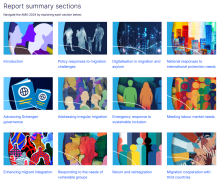
The European Migration Network (EMN) has published its Asylum and Migration Overview 2024, with contributions from 30 Member and Observer Countries. The Belgian and EU-wide reports are both made available today, with the European report presented today 9 July 2025 at an online launch event gathering over 260 participants. For the first time, the EU report is available in an interactive format offering dynamic access to key data and trends.
Read more
Main theme: Cross-sectional, Asylum, Migration
Keywords: Asylum and Migration Overview, interactive format, interactive map
Publication date:
From 1 July to 31 December 2025, Denmark will hold the Presidency of the Council of the European Union. The Presidency’s programme emphasises key priorities such as tackling irregular migration, strengthening border control, and fostering cooperation with partner countries. It also aims to enhance legal migration pathways and address the situation of displaced persons.
Read more
Main theme: Cross-sectional, Asylum, Migration
Keywords: Danish Presidency, Council of the European Union
Publication date:
Myria has published the first thematic section of its 2025 annual report. This section, entitled "Population and movements", reveals that foreign nationals made up over 13% of the Belgian population as of 1 January 2024. Immigration from Romania, France and Ukraine was particularly high. The report also details key trends in foreign residence permits, demographic profiles and migratory flows.