The European Commission and the High Representative of the Union for Foreign Affairs and Security Policy have proposed a new horizontal EU sanctions regime targeting migrant smuggling, trafficking in human beings and other serious forms of organised crime. The proposed framework would allow the European Union to impose restrictive measures on individuals and entities involved in such activities originating outside the EU where they pose a serious threat to the Union's values, the security of the EU and its Member States, or to international security. The proposals will now be examined by the Council.
08/07/2026
The Belgian Council of State has suspended the decision of the Minister of Asylum and Migration to limit material reception conditions for applicants for international protection who have already obtained protection in another EU Member State. In its judgment No. 267.364 of 8 July 2026, the Council of State suspended the measure following an urgent appeal introduced by several organisations active in the field of asylum and migration. The decision concerns a measure adopted following the entry into application of the European Pact on Migration and Asylum on 12 June 2026.
07/07/2026
The Minister of Asylum and Migration, the Belgian Immigration Office and the municipality of Nazareth-De Pinte have announced the opening of a new European Return Centre in Nazareth-De Pinte in autumn 2026. The centre will have a capacity of 300 places and will accommodate applicants for international protection for whom another EU Member State may be responsible for examining their application. The facility will complement the existing Centre in Zaventem and aims to support procedures related to transfers to the responsible Member State.
04/06/2026
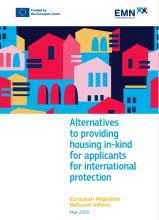
This Inform, covering developments across 22 EMN Member Countries, as well as Norway and Serbia, explores the use of alternatives to providing in-kind housing for applicants for international protection between January 2020 and October 2025. It examines how such measures were implemented while respecting legal obligations and supporting applicants’ autonomy, addressing their vulnerability, and promoting their integration into society. The Inform focuses on financial allowances and vouchers as alternatives to accommodation provided directly by the state and highlights national approaches and innovative solutions identified across participating countries.
Theme:
Publication type:
Keywords:
27/05/2026
This ad hoc query examines whether EMN Member and Observer Countries experience irregular occupancy within their reception systems. It explores whether countries have mechanisms that allow individuals in the reception system to save part of their income to facilitate access to independent housing, or whether direct financial support is provided. The query also considers whether countries have mechanisms for individuals who unjustifiably refuse to leave the reception system, as well as any financial reimbursement mechanisms for costs incurred when an individual remains irregularly.
Theme:
Publication type:
Keywords:

05/05/2026
The Belgian Commissioner General for Refugees and Stateless Persons (CGRS) announces a series of changes that will apply from 12 June 2026. These changes are part of the implementation of the EU Pact on Migration and Asylum, adopted in 2024. They will affect asylum procedures, operational practices and new institutional responsibilities.
29/04/2026
In 2025, minors accounted for 23.7% of all first-time asylum applicants in the European Union, according to recent Eurostat data. A total of 158.400 children applied for asylum for the first time, including a significant proportion of unaccompanied minors. While the overall number of minor applicants declined compared to previous years, children continue to represent a substantial share of asylum seekers in the EU.
Theme:
Type:
Keywords:
27/04/2026
The Council for Alien Law Litigation (CALL) has made the use of its child-friendly courtroom (“Salle M”) a structural arrangement as of March 2026. The measure applies to asylum appeal cases involving unaccompanied minors and is accompanied by adapted summonses, age-appropriate information materials, and strengthened judicial training on children’s rights. The initiative builds on a pilot phase and forms part of broader European efforts to enhance child-friendly justice.

23/04/2026
Coastal rescue services along the Belgian North Sea are being briefed on how to respond to increased small boat activity linked to attempted irregular crossings towards the United Kingdom. The sessions aim to strengthen awareness and improve coordination with relevant authorities ahead of the start of the beach surveillance season.
Theme:
Type:
Keywords:
16/04/2026
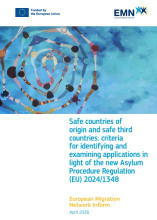
This Inform maps national approaches to the safe country of origin (SCO) and safe third country (STC) concepts, in the context of the forthcoming Asylum Procedure Regulation applicable from June 2026. It compares legislation, policies and practices governing the designation and application of SCOs and STCs, including the use of national lists, ad hoc assessments and accelerated asylum procedures. The analysis was prepared on the basis of contributions from 26 EMN Member and Observer Countries.
Theme:
Publication type:
Keywords:

13/04/2026
Belgian Minister for Asylum and Migration Anneleen Van Bossuyt is carrying out a visit to the Democratic Republic of Congo. The visit takes place in the context of a marked increase in asylum applications from Congolese nationals in Belgium in recent years. The mission aims to discourage unfounded asylum applications, address the misuse of visa procedures, counter document fraud and misleading messages from smugglers, and strengthen cooperation on return and the fight against irregular migration.
10/04/2026
This ad hoc query examines whether EMN Member Countries plan to change their age assessment procedures in light of Article 25 of Regulation (EU) 2024/1348 on multidisciplinary age assessments. It explores which authorities or external providers are involved in the procedure, and how multidisciplinary teams carry out the assessment in practice. The query also covers how applicants are interviewed and how conclusions are drawn and communicated.
Theme:
Publication type:
Keywords:
09/04/2026
On 9 April 2026, the European Court of Human Rights delivered its judgment in M.V. and Others v. Belgium and held that Belgium had violated several provisions of the European Convention on Human Rights in relation to the reception conditions of four applicants for international protection.
28/03/2026
The Fedasil Pondrôme reception centre will host a photo exhibition featuring the work of unaccompanied and accompanied minors. The images were created over an eighteen-month project led by CIDJ Rochefort–Beauraing. The exhibition provides insight into the daily lives, experiences, and identities of the young participants. The event is free, open to all, and offers an opportunity to meet the creators.

31/03/2026
On 31 March 2026, the Office of the Commissioner General for Refugees and Stateless Persons (CGRS) announced that it would temporarily suspend the notification of certain decisions in cases concerning applicants from Lebanon, in view of the current situation in the country.
27/03/2026
The Belgian Council of State has suspended a ministerial instruction that systematically limited material assistance to international protection applicants who had already obtained protection in another EU Member State. The court ruled that the instruction exposed these individuals to the risk of severe hardship and potential homelessness. It also noted that, due to its regulatory character, the instruction should have been submitted for review by the Council of State’s Legislation Section.
Theme:
Type:
Keywords:
27/03/2026
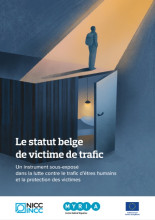
The report provides an in‑depth overview of Belgium’s status for smuggling victims, highlighting its objectives, legal framework, and practical implementation. It examines how the status is applied, who benefits from it, and the operational challenges encountered. The publication also identifies gaps in data collection and coordination between agencies. Finally, it offers evidence‑based recommendations to strengthen victim protection and improve the overall effectiveness of the system.
Theme:
Publication type:
Keywords:
08/01/2026
This conference will address the pressing issue of human trafficking affecting young people in Belgium, including sexual exploitation, forced criminality, and economic exploitation. It will bring together international experts, as well as Minister Yves Coppieters, responsible for Women’s Rights and Equal Opportunities, to discuss the current situation, share experiences, and highlight effective measures to protect youth. The Samilia Prize will be presented later in the evening.
Theme:
Type:
Keywords:
05/12/2025
The TRAQ study day will take a close look at the status of victims of smuggling in human beings under aggravating circumstances in Belgium. Introduced in 2006, this residence status for victims who cooperate with authorities has seen limited use and has never been thoroughly analysed. Within the framework of « TRAQ » (Trafic Analyses Qualitatives), Myria and the National Institute of Criminalistics and Criminology (INCC) conducted a study on its implementation. The findings will be shared to stimulate discussion and reflection among experts and stakeholders.
Theme:
Keywords:
25/03/2026
Belgian judicial and law enforcement authorities contributed to an operation targeting a criminal network supplying small boats for migrant crossings. Four high-level suspects were arrested in Germany and are expected to be extradited to Belgium for prosecution in Bruges. Searches in Germany and Belgium resulted in the seizure of boats, engines, life jackets, cash, and other equipment used in the smuggling activities.
Theme:
Type:
Keywords:

24/03/2026
On 24 March 2026, Europol has launched the European Centre Against Migrant Smuggling (ECAMS) in The Hague. The centre is intended to strengthen the EU’s response to migrant smuggling networks. It focuses on intelligence-led, data-driven and financial investigations. The initiative builds on over a decade of operational work, including the European Migrant Smuggling Centre established in 2016, which supported Member States through arrests, network dismantling and joint operations.
Theme:
Type:
Keywords:

20/03/2026
Belgium plans to progressively return several defence sites used for the reception of applicants for international protection to military use as part of a broader plan to expand defence infrastructure towards 2040. The measure concerns around 4.000 reception places located on military premises across the country. Authorities state that the reduction in capacity can be absorbed within the existing reception network. The transition will take place gradually, with closures scheduled at different times depending on the site.
19/02/2026
The Klarafestival 2026 in Brussels brings together audiences, musicians, and participants from diverse backgrounds around the theme “Where is Home?”. The festival combines classical music concerts with additional activities such as conferences and discussions. It also engages in social initiatives, giving young talents a platform and reaching communities that do not usually experience live classical music. In 2026, particular attention is given to refugees, highlighting the importance of having a safe home and a sense of belonging.

18/03/2026
The Netherlands has decided to resume Dublin transfers of single, non-vulnerable male asylum seekers to Belgium, following a period in which such transfers were suspended after a Dutch court ruling. In April 2025, the District Court of The Hague, sitting in Groningen, found that single male asylum seekers risked being deprived of adequate reception conditions in Belgium, which could expose them to inhumane or degrading treatment. The ruling led to a halt in transfers under the EU Dublin system.
Theme:
Type:
Keywords:
18/03/2026
This ad hoc query examines whether EMN Member and Observer Countries have age assessment procedures in place, how these procedures are conducted, and which actors are responsible. It also explores the challenges encountered and how they are addressed. Finally, it examines whether the respondent countries plan to introduce a new procedure or amend an existing one in the near future.