As of today, 1 January 2024, the people of Kosovo with biometric passports no longer require visas when travelling for short stays of up to 90 days in any 180-day period to all 27 Schengen Area countries.
Other government information and services: belgium.be
As of today, 1 January 2024, the people of Kosovo with biometric passports no longer require visas when travelling for short stays of up to 90 days in any 180-day period to all 27 Schengen Area countries.
Today, the European Parliament adopted a resolution wrapping up the fact-finding investigation by the Working Group on Frontex Scrutiny with 366 votes in favour, 154 against, and 15 abstaining. The Members of the European Parliament (MEPs) inter alia share concerns over the situation in Greece, Lithuania and Hungary.
EMN Serbia, which newly joined the European Migration Network as an Observer Country in March 2023, organises its first national conference. The conference will focus on circular migration schemes and diasporas moving back to their countries of origin.
The national conference organised by EMN Austria this year will facilitate an insightful discussion among experts on the efficient and humanitarian management of EU’s external borders.
A Belgian expert participated in the conference of the Austrian Contact Point to the European Migration Network (EMN) focusing on opportunities and challenges in the management of EU's external borders. Participants inter alia identified the weaponization of migration as a major challenge concerning the protection of EU's external borders.
The Ombudsman is asking whether the Commission conducted a human rights impact assessment before signing the agreement, if periodic reviews will be conducted during implementation, and if there are criteria for suspending funding in case of human rights violations.
Frontex revealed today that the number of detections of irregular border crossings at EU’s external borders rose by one fifth (+18%) in the first eight months of 2023 to over 232 350 and that this increase was primarily driven by the number of arrivals through the Central Mediterranean, which remains the main migratory route into the EU.
Due to the increased need for foreign labour force, Member States are multiplying their negotiations of bilateral agreements and programmes with third countries on labour mobility. In order to have a current state of play and with a view to better coordinate this matter, the European Commission asked EMN Member countries to provide information on any bilateral agreement or programme supporting mobility from third countries.
This hybrid annual conference will debate the latest developments and challenges in the EU’s internal and external border management. It will analyse the latest proposals and reforms on the functioning and operation of EU border management systems, including Schengen, as well as Frontex’ role and responsibilities. A particular focus will be given to the ongoing situation at the EU’s eastern border.
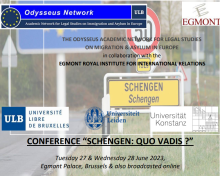
This conference will examine the issues at the core of the current debates about Schengen like the balance between solidarity & responsibility between States in liaison with secondary movements of asylum seekers, the persistence of controls at Schengen internal borders, the way to monitor human rights at the external borders, the increasing recourse to large-scale databases,...
This seminar will examine new findings on how Schengen emerged, how its current design was shaped and which topics are likely to dominate the future political agenda.
Today, the Commission adopted a Communication on the monitoring of the EU's visa-free travel regimes setting out a consultation process. To address challenges and prevent risks effectively, existing rules concerning the monitoring of the functioning of visa-free regimes with third countries and the suspension of visa exemptions should be re-assessed and improved.
This report is part of the Commission's initiative to further reinforce the Schengen governance through a yearly reporting exercise presenting the state of Schengen, identifying challenges and best practices, as well as priority areas for action. The State of Schengen Report 2023 will serve as basis for political discussions and steer at the Council on 8 June 2023.
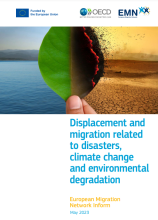
As more and more people are affected by climate change, the need to understand and prepare for climate-related migration has increased. This inform aims to complement existing research by providing a broader perspective on how displacement and migration related to disasters, climate change and environmental degradation are being addressed by key national-level initiatives and policies in EMN Member Countries as well as non-EU OECD countries.
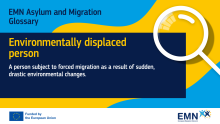
The European Migration Network (EMN) Glossary is an essential resource, which offers an EU-wide multidisciplinary vocabulary of approximately 500 terms and concepts related to asylum and migration. Let's focus today on the term "environmentally displaced person" to make sure we have a common understanding and use of the term!
Myria has published the first thematic section of its 2023 annual report. This section entitled "Access to the territory" presents the main key figures relating to short and long-stay visas as well as the different reasons and nationalities that stood out in 2022.
Ahead of the Artificial Intelligence Act vote in the European Parliament, a coalition of human rights organisations is calling on EU lawmakers to include provisions in the proposed EU AI Act to protect people from AI surveillance technologies used in migration.
Today EMN Belgium visited Enabel partners to discuss themes and activities of common interest. Both the EMN Belgium team and the Enabel staff members in charge of human mobility and of strategic partnerships look forward to working together even more closely in the future.
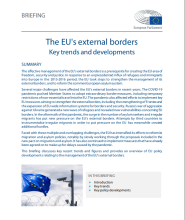
Several major challenges have affected the EU's external borders in recent years, including the COVID-19 pandemic and Russia's war of aggression against Ukraine. These multiple challenges impacted figures and trends and urged policy developments which are clearly presented in a briefing released today by the European Parliament.
This briefing discusses key recent trends and figures and provides an overview of EU policy developments relating to the management of the EU's external borders.
Today, the Commission adopted a Communication that presents the strategic framework for European integrated border management (EIBM) for 5 years and a Recommendation to Member States on the mutual recognition of return decisions and expediting returns.
Today the upgraded Schengen Information System (SIS) enters into operation to enhance security and border management in Europe. The renewed SIS is being enhanced to include new categories of alerts, biometrics such as palm prints, fingermarks, and DNA records for missing persons, and additional tools to combat crime and terrorism.
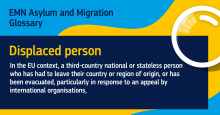
The European Migration Network (EMN) Glossary is an essential resource, which offers an EU-wide multidisciplinary vocabulary of approximately 500 terms and concepts related to asylum and migration. Let's focus today on the term "displaced person" to make sure we have a common understanding and use of the term!
This Inform explores which national strategies, successful programmes and initiatives have been implemented in the EMN Member Countries to enhance the prospects for displaced persons in non-EU first reception and transit countries, and how these strategies have been integrated within existing EU and international frameworks and agreements.
The 2nd European Border Managament Conference was held in Athens on 23 and 24 February 2023. Participating Member States inter alia underlined the importance of effective control of EU's external borders and required legal, financial, operational and technical measures as well as a whole-of-the-route approach to ensure this.