The Minister of Asylum and Migration, the Belgian Immigration Office and the municipality of Nazareth-De Pinte have announced the opening of a new European Return Centre in Nazareth-De Pinte in autumn 2026. The centre will have a capacity of 300 places and will accommodate applicants for international protection for whom another EU Member State may be responsible for examining their application. The facility will complement the existing Centre in Zaventem and aims to support procedures related to transfers to the responsible Member State.
07/05/2026
The Court of Justice of the European Union has ruled on the compatibility of a national residence requirement with EU equal treatment rules. The Court examined whether a 10-year residence condition could be applied to beneficiaries of international protection in order to access a social benefit. It found that the measure constitutes indirect discrimination prohibited under EU law.

07/05/2026
DUO for a JOB has launched a national awareness campaign highlighting the persistence of discrimination in recruitment processes in Belgium. The initiative uses the format of the well-known game “Guess Who?” to illustrate how candidates may still be excluded on the basis of appearance, name, origin or accent rather than skills. The campaign is being rolled out in May across public spaces, including stations and metro networks in several Belgian cities.

05/05/2026
The Belgian Commissioner General for Refugees and Stateless Persons (CGRS) announces a series of changes that will apply from 12 June 2026. These changes are part of the implementation of the EU Pact on Migration and Asylum, adopted in 2024. They will affect asylum procedures, operational practices and new institutional responsibilities.
29/04/2026
In 2025, minors accounted for 23.7% of all first-time asylum applicants in the European Union, according to recent Eurostat data. A total of 158.400 children applied for asylum for the first time, including a significant proportion of unaccompanied minors. While the overall number of minor applicants declined compared to previous years, children continue to represent a substantial share of asylum seekers in the EU.
Theme:
Type:
Keywords:
27/04/2026
The Council for Alien Law Litigation (CALL) has made the use of its child-friendly courtroom (“Salle M”) a structural arrangement as of March 2026. The measure applies to asylum appeal cases involving unaccompanied minors and is accompanied by adapted summonses, age-appropriate information materials, and strengthened judicial training on children’s rights. The initiative builds on a pilot phase and forms part of broader European efforts to enhance child-friendly justice.

13/04/2026
Belgian Minister for Asylum and Migration Anneleen Van Bossuyt is carrying out a visit to the Democratic Republic of Congo. The visit takes place in the context of a marked increase in asylum applications from Congolese nationals in Belgium in recent years. The mission aims to discourage unfounded asylum applications, address the misuse of visa procedures, counter document fraud and misleading messages from smugglers, and strengthen cooperation on return and the fight against irregular migration.

31/03/2026
On 31 March 2026, the Office of the Commissioner General for Refugees and Stateless Persons (CGRS) announced that it would temporarily suspend the notification of certain decisions in cases concerning applicants from Lebanon, in view of the current situation in the country.

20/03/2026
On 20 March 2026, the Belgian Council of Ministers approved a draft law that would link the level of social assistance granted to beneficiaries of subsidiary and temporary protection to their participation in integration efforts through the Individual Social Integration Project (ISIP). Under the proposal, the amount of social assistance could be adjusted depending on the efforts made by the beneficiary to integrate.
18/03/2026
The Netherlands has decided to resume Dublin transfers of single, non-vulnerable male asylum seekers to Belgium, following a period in which such transfers were suspended after a Dutch court ruling. In April 2025, the District Court of The Hague, sitting in Groningen, found that single male asylum seekers risked being deprived of adequate reception conditions in Belgium, which could expose them to inhumane or degrading treatment. The ruling led to a halt in transfers under the EU Dublin system.
Theme:
Type:
Keywords:

16/03/2026
The Office of the Commissioner General for Refugees and Stateless Persons (CGRS) has announced that it will resume processing cases from applicants originating from the West Bank who are not registered with UNRWA. The decision follows a temporary suspension in March 2025 due to the unstable situation in the region. The CGRS now has sufficient up-to-date and objective information to assess the need for international protection.
Theme:
Type:
Keywords:
03/03/2026
According to the Latest Asylum Trends 2025 published by the European Union Agency for Asylum (EUAA), EU+ countries received approximately 822.000 applications for international protection in 2025, representing a 19 % decrease compared to 2024. Despite the overall decline, demand for protection remained significant in some groups and countries.
05/02/2026
The European Parliament has approved new EU asylum rules to enable faster processing of asylum requests. The reform establishes a common list of safe countries of origin while allowing Member States to maintain or designate additional safe countries at national level. It also clarifies the conditions under which Member States can apply the safe third country concept. While the legislation has now passed Parliament, it still needs to be formally adopted by the Council before entering into force.
Theme:
Type:
Keywords:

27/01/2026
In 2025, Belgium received 34.439 applications for international protection, a decline compared with 2024. The Office of the Commissioner General for Refugees and Stateless Persons (CGRS) took decisions on 31.457 people, with a protection rate falling to its lowest level in over a decade. Key factors behind this trend include the suspension of the processing of Syrian cases in the first ten months of 2025 and prioritisation of applications from individuals already protected in other EU Member States.
Theme:
Type:
Keywords:

15/01/2026
The Office of the Commissioner General for Refugees and Stateless Persons (CGVS) announced on 15 January 2026 that it is temporarily suspending the processing of applications for international protection from Iranian nationals. The CGVS stated that, given the current situation in Iran and the difficulty in obtaining sufficiently reliable and up-to-date information, it is currently unable to assess the need for protection accurately.
Theme:
Type:
Keywords:
08/01/2026
On 8 January 2026, the Resettlement Coalition issued a joint statement expressing concern over the European Union’s newly adopted Union Resettlement and Humanitarian Admission Plan (URP) for 2026–2027. While welcoming the plan’s adoption as a step towards embedding resettlement in EU migration policy, the coalition highlighted that the number of pledges is dramatically lower than previous commitments and that the eligibility criteria are narrow. The statement calls on EU Member States to increase their contributions and ensure that protection needs remain central to resettlement efforts.
01/01/2026
From 1 January 2026, the Onder1Dak project, which promotes co-housing between private homeowners and recognised refugees in Flanders, has restarted following renewed support from the Flemish Minister for Civic Integration and Integration. The initiative aims to facilitate access to housing while supporting the social and professional integration of recognised refugees.

23/12/2025
On 23 December 2025, the Belgian Council of Ministers approved a draft law linking social assistance to integration efforts. For recognised refugees, the draft law foresees that the Individual Social Integration Project (ISIP) should include, at a minimum, participation in an integration path. Other newcomers, including third-country students and economically inactive EU citizens, would now need to have legally resided in Belgium for five years before becoming eligible for social assistance.
Theme:
Type:
Keywords:
08/12/2025
The Council of the European Union has agreed its position on two key proposals to strengthen the use of safe country concepts in EU asylum rules. One addresses the safe third country concept, and the other establishes the first EU‑wide list of safe countries of origin. They aim to accelerate asylum procedures and improve the management of applications from those unlikely to require protection. Negotiations with the European Parliament, which has also endorsed the list, will follow to agree on the final texts.
Theme:
Type:
Keywords:
02/12/2025
During a session of the Chamber of Representatives’ Interior Committee on 2 December 2025, Minister Anneleen Van Bossuyt outlined the government’s decision regarding the list of safe countries of origin. She specified which countries are included in the 2025 list and explained that Morocco was added due to improvements in its human rights situation and the low recognition rate for asylum applications from Moroccan nationals.

01/11/2025
The Office of the Commissioner General for Refugees and Stateless Persons (CGRS) is resuming the processing of applications for international protection from Syrian nationals from 1 November 2025. The suspension, in place since 9 December 2024, was implemented to gather sufficient information on the security situation in Syria.
Theme:
Type:
Keywords:
31/10/2025
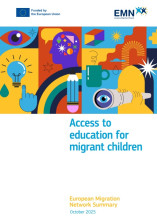
On 31 October 2025, the European Migration Network (EMN) released its latest Inform highlighting how 25 EMN Member and Observer Countries are addressing access to education for migrant children. The report shows that nearly all participating countries have adopted national measures to support linguistic, social, and emotional integration in schools. Despite persistent barriers, such as language difficulties and unequal learning outcomes, good practices are emerging across Europe, according to this Inform.
Theme:
Type:
Keywords:
29/09/2025
The Flemish government has decided that third-country workers – from outside the EU, Iceland, Liechtenstein, Norway and Switzerland – will follow a mandatory tailored integration trajectory from 2027. The initiative, proposed by Minister Hilde Crevits, will be delivered digitally and can be started in the country of origin or within six months of arrival in Flanders. The programme provides essential information on work, rights and responsibilities, and Flemish norms and values. Certain temporary or seasonal workers, students, and holiday-work participants are excluded.
Theme:
Type:
Keywords:
08/09/2025
Asylum applications in EU+ countries fell by nearly a quarter in the first half of 2025, according to the European Union Agency for Asylum (EUAA). A sharp decline in requests from Syrians, following political change in the country, shifted the profile of applicants across Europe. Venezuelans became the largest group seeking protection, while Germany lost its position as the main destination country. Recognition rates reached a record low, reflecting procedural factors and changes in applicant composition.
27/08/2025
In August 2025, the European Union Agency for Asylum (EUAA) introduced a Self-Assessment Tool to help national authorities evaluate the quality of their asylum procedures. Based on EUAA operational standards and indicators, the tool provides a structured method for self-assessment. It aims to help administrations identify areas for improvement and ensure compliance with EU standards. A descriptive version of the tool is currently available to guide implementation.