EMN Belgium brings together key stakeholders involved in asylum and migration for its 2026 policy event
On 26 May 2026, EMN Belgium gathered over 130 key stakeholders in the fields of asylum and migration. This event also marked the launch of the Belgian Asylum and Migration Overview 2025, which highlights the principal developments in asylum and migration in Belgium over the previous year. The diverse audience of experts engaged in reflection and discussion on recent trends in the field, as well as on strengthened cooperation within the Belgian asylum and migration system. The day also included breakout session on key topics, alongside informal networking to build connections and inspire new collaborations.
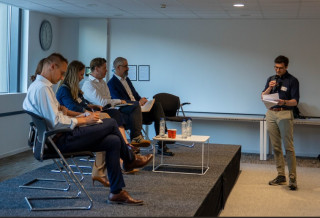
The policy event opened with remarks from the EMN Belgium team, addressing a large audience of experts, including representatives from ministerial cabinets, asylum, immigration, and reception authorities, regional administrations, international organisations, civil society organisations, and academia.
The morning session began with a keynote speech by Thomas Huddleston, researcher at the University of Liège. He delivered an insightful lecture on the EMN Belgium Overview 2025, presenting key findings on asylum and migration, as well as comparative research results. Additionally, he briefly shared the initial findings of a survey conducted by BPACT last year regarding the Belgian public’s views on migration. His presentation highlighted the importance of robust data and comparative research in informing evidence-based policymaking and fostering a better understanding of migration trends and public perceptions.
Following the lecture, a session on integrated approaches and cooperation within Belgium’s asylum and migration framework took place. It was introduced by Pieter-Jan Van Bosstraeten, attaché in the cabinet of the Minister for Asylum and Migration, who underlined the accelerating pace of EU asylum and migration developments and their de facto impact on the organisation of asylum and migration cooperation in Belgium. Moderated by Luc Leboeuf (ULiège), the panel featured contributions from Marie Vanderveken (FPS Home Affairs), Peter Van Costenoble (FPS Home Affairs), Bieke Vens (FPS Home Affairs), Bart Theunis (CGRS) and Tim Lagrange (Fedasil). The discussion explored the importance of strengthened cooperation and an integrated approach, existing frameworks and initiatives, key success factors and challenges, as well as future opportunities. It drew on concrete examples, including the implementation of the EU Pact on Migration and Asylum, the work of the chain monitoring unit, and the creation of the future Federal Public Service for Migration, which helped to illustrate these issues in practice. The panel brought together complementary perspectives, ranging from the European to the national level, as well as coordination and strategic perspectives, and operational perspectives from asylum and reception authorities.
Participants then delved into various topics during breakout sessions:
- Entry Exit System (EES): more efficient, simpler and faster? A state of play after the lastest stamp: This session featured presentations by a specialist from the Border Management Directorate of the Immigration Office and a specialist from the Federal Police. The experts explored the practical implementation and early results of the Entry/Exit System (EES), highlighting how biometric registration has streamlined access to travel and stay data for border authorities while offering third-country nationals greater transparency regarding their authorised stay. However, the first seven months of operation reveal that heightened security and additional registration requirements do not automatically lead to faster border crossings, as increased control measures can impact the flow of passengers. While the technical transition from physical stamps to digital biometrics is complete, the process requires continuous fine-tuning to manage system disruptions and prepare for future developments like ETIAS and broader system interoperability. Furthermore, the EES has resulted in a shift in workload rather than a simple reduction; administrative complexity in the back-office has grown due to the need for precise data correction, even as the system provides more robust tools to combat irregular migration. Ultimately, the system’s effectiveness acts as a "flywheel" for interoperability, where the integration with other European databases (such as VIS and ETIAS) enables more efficient detection of identity fraud and "overstayers," provided that technical interfaces function seamlessly. Following the presentation, a discussion session for questions and remarks allowed for further insights which helped shape these conclusions.
- Syria: protection and return in a post-conflict context: The session examined protection and return to Syria in a changing post-conflict context, with contributions from CGRS, Fedasil and IOM. CGRS presented recent asylum trends for Syrian nationals in Belgium, noting that more than 52,000 Syrian applicants were registered between 2011 and 2025, with applications peaking in 2015, and that 46% of applicants were men and 54% women. CGRS also highlighted the sharp drop in protection rates in 2025 following the reassessment of protection needs. IOM presented the results of a study on the mobility intentions of Syrians in Belgium, commissioned by IOM Belgium and co-funded by the European Union and Fedasil. Based on 351 quantitative phone surveys and 20 in-depth interviews, the study showed that while 45% of surveyed Syrians expressed willingness to return, only 7% intended to do so within the next 12 months. The study also identified key barriers to return, including safety concerns, economic instability, lack of housing, damaged infrastructure, missing documentation and unresolved housing, land and property issues. Fedasil presented Belgium’s voluntary return and reintegration support for Syria, including increased financial assistance funded through both national contributions and the European Return and Reintegration Programme, as well as the degressive support model aimed at encouraging earlier voluntary return. The discussion underscored that financial support must be combined with counselling, individual reintegration planning, and realistic expectations, as sustainable reintegration depends on security, livelihoods, and access to services. Questions were also raised about the potential use of “go and see” visits, as well as the impact of mandatory return decisions on persons receiving return and reintegration support in the context of voluntary return.
- The (early) integration of applicants for international protection in Wallonia: The session gathered experts from Fedasil, the Regional Integration Centre of the Province of Luxembourg, and the Red Cross. Together, they explored the evolving concept of early integration, engaging directly with participants in the discussion. The discussion highlighted how the one-clear distinction between reception and integration is now blurring, thanks to innovative initiative in the framework of early-integration. It emphasised the need for policies and projects to be shaped by the needs of the applicants, ensuring they are equipped with the tools, information, and ressources to achieve true autonomy. Beyond economic integration, early-integration was framed as a process broader than financial contribution through employment, encompassing social and cultural engagement, as well as the meaningful interactions that unfold with the host society.
- The Concentric Model for Labour Migration in Policy and Practice: The law firm Fragomen, specialised in economic immigration law, presented the findings of two EMN studies (here and here), before engaging in a discussion with experts from the Regional Integration Centre of the Province of Luxembourg, the Flemish Public Employment Service (VDAB) and the Brussels Region. The session explored the practical implementation of Belgium’s concentric model, revealing how the country’s complex institutional structure poses significant challenges, including regional differences in qualification recognition and work permit conditions, as well as funding shortages for cooperation. A significant untapped labor potential exists, particularly among people with migration backgrounds, but a skills-job mismatch persists, requiring better recognition, training, and employer involvement. The model’s success also depends on alignment with broader socio-economic policies like housing and education. Practitioners noted additional nuances, such as internal hiring practices and the growing trend of posted workers, who fall outside the model’s scope.
- Minor victims of trafficking and/or aggravated smuggling in Belgium: better understanding for better action: The session, which featured contributions from Myria, the Federal Judicial Police and Esperanto, sought to better understand why, despite a high number of minors considered at high risk of being or becoming victims, only a limited number are effectively detected, referred and taken in charge by specialised actors, including Esperanto, Meza and the three specialised reception centres. It therefore explored the main obstacles along the chain of detection, referral and care. Participants identified early detection and recognition of minor victims of trafficking in human beings and/or aggravated smuggling as a fundamental challenge, as this initial step determines subsequent identification, referral and support. The system still struggles to effectively spot these victims due to factors such as digitalisation, the blurring of lines between victims and perpetrators, and obstacles to information sharing. Initial interactions with (potential) victims remain pivotal; however, their effectiveness depends on adequate skills, resources, training, time, institutional capacity and engagement. The session further underscored the need to reassess whether existing reception arrangements are adequate for the evolving profiles of young victims, particularly those who refuse shelter, suffer from severe addictions, or display violent behaviour, highlighting the importance of low-threshold, street-level services as a first point of contact. Finally, it concluded that shared responsibility among all actors – including police officers, judges, NGOs and others – is essential to strengthen awareness and improve the detection, referral and care of minor victims.
- Exclusion, refusal, and withdrawal of international protection for perpetrators of serious crimes: Article 1F, public order and national security: Experts from the CGRS highlighted the legal complexity of refusing or withdrawing refugee status on public order grounds, emphasising that two cumulative conditions must be independently established; a particularly serious offense and a real, current, and sufficiently serious threat to a fundamental societal interest. A mere conviction is insufficient – an individualised assessment is essential. Furthermore, withdrawing refugee status does not nullify the individual’s refugee status itself, as protection against refoulement persists as long as the risk of persecution remains. The experts stressed that the legal framework is still taking shape. The CGRS has to observe closely how rulings are judged by courts, especially the Council for Alien Law Litigation (CALL). Case law from the CJEU and the CALL shows that insufficient justification frequently leads to the annulment of decisions, setting a stringent standard for authorities. Striking a balance between state and societal interests and the protection of individual rights remains a particularly nuanced challenge. CGRS experts also emphasised the difficulties in obtaining the comprehensive information needed for thorough case assessments—whether domestic (criminal records, detention reports, psychiatric evaluations, or probation monitoring) or international (convictions or legal proceedings in other states). Without this information, evaluating the real and current threat—a prerequisite for any decision—remains inherently incomplete. Consequently, enhancing structural information exchange and collaboration among relevant actors emerges as a pressing necessity.
For more information about the lecture and breakout sessions mentioned above, please refer to the PowerPoint presentations below. If you would like to view photos from the event, please visit this page.
The team of EMN Belgium is honoured and grateful to count on such a rich and diverse network of experts! We sincerely thank each and every one of you for your active and essential contributions to the discussions held during the policy event.