EMN Belgium and EMN Sweden host an EU launch seminar on migration and development cooperation
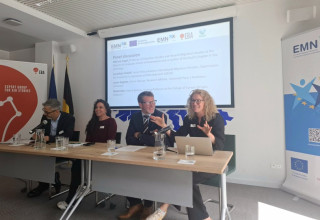
On 4 June 2026, EMN Belgium and EMN Sweden, together with the Swedish Expert Group for Aid Studies (EBA) and the Swedish Migration Studies Delegation (Delmi), organised the EU launch seminar “Linking Migration and Development Cooperation: European Experiences and Policy Reflections” at the Permanent Representation of Belgium to the EU in Brussels.
The event marked the EU launch of the anthology "Linking Migration and Development: European Experiences and Policy Lessons for Sweden". Building on the 2024 EMN Inform on Migration and Development Cooperation, developed by EMN Sweden and EMN Belgium together with several Member States, the anthology examines how Denmark, Norway, the Netherlands, and Germany have approached the links between migration policy and development cooperation over the past decade.
With around 80 participants, the seminar brought together a broad audience from public authorities, EU institutions, international organisations, academia, think tanks, civil society, diaspora organisations, embassies and permanent representations.
The seminar opened with welcome remarks by Hugo Verbist, Special Envoy for Migration at the Belgian Federal Public Service Foreign Affairs, Foreign Trade and Development Cooperation. He highlighted EMN’s role in providing reliable information and supporting evidence-based policymaking. He also referred to the 2024 EMN Inform as an important basis for the discussions. He underlined the importance of well-governed migration, sustainable development, multilateralism and strong partnerships with third countries.
Bogdana Sybikowska from DG HOME and Samuel Simon Pulido from DG INTPA presented EU priorities for external migration engagement in the context of the Pact on Migration and Asylum. They addressed key elements of the Pact, including screening, border procedures, solidarity, returns and safeguards for fundamental rights, as well as cooperation with third countries on migration governance, legal pathways, return, readmission and reintegration.
The anthology was introduced by Iris Luthman and Henrik Malm Lindberg from Delmi, together with Mats Hårsmar from EBA. Their presentation focused on a central question: not whether migration and development are linked, but how this link is governed in practice and with what effects. Drawing on experiences from Denmark, Germany, the Netherlands and Norway, they showed that migration has become a more prominent reference point in development cooperation, while approaches differ significantly across countries. They also stressed the need for realistic objectives, clear coordination, transparency about trade-offs, safeguards for rights and partner ownership, and stronger evidence on what migration-related development cooperation can realistically achieve.
The country perspectives from the Netherlands, Germany and Belgium illustrated how different national approaches have developed in practice. Arjen Leerkes presented the Dutch experience, in which development cooperation has increasingly been used as part of migration governance, including through return and reintegration initiatives, information campaigns and mobility partnerships. He underlined that expectations should remain realistic, as the impact of such instruments on migration dynamics is often modest, indirect and difficult to measure. Anna Knoll presented Germany’s whole-of-government approach, showing how migration has become a cross-cutting issue within Germany’s development cooperation agenda. Her presentation also highlighted tensions between development objectives and migration policy priorities, for example, in the areas of labour mobility, return and reintegration. Raffaella Greco Tonegutti presented the Belgian perspective on development cooperation. She highlighted the role of Enabel in supporting partner countries to govern migration and displacement in ways that strengthen their development potential and reduce related risks. She also underlined the importance of a whole-of-government approach, including in areas such as sustainable reintegration, labour mobility, diaspora engagement and development solutions in displacement contexts.
The final policy-oriented discussion, moderated by Hanne Beirens, brought together Melissa Siegel, Jonathan Chaloff and Jason Gagnon. The discussion explored how migration and development objectives can be better aligned in practice, while taking into account development principles, partner ownership, rights, evidence and operational realities. Exchanges with participants further enriched the debate. Reflections focused, among other issues, on the role of public-private partnerships, including possible mismatches between private-sector needs and public policies or priorities. Participants also noted that Member States may prioritise countries of origin that do not always align with those most relevant to private-sector actors. The exchanges also touched on the importance of gender mainstreaming in migration-related development cooperation and included reflections on conditionality from a partner country's perspective. The discussion further underlined the need to scale up programmes if they are expected to have a meaningful impact, while avoiding overestimating the leverage that small-scale actions can create in broader agreements with countries of origin.
The seminar confirmed the value of bringing together research, policy and operational experience at the EU level. Participants stressed the need for evidence-based and realistic discussions on the migration-development nexus, avoiding overly broad claims while identifying concrete areas where development cooperation can contribute to migration governance, sustainable return and reintegration, protection, mobility and partnerships.
The seminar closed with remarks by Hugo Rickberg, Senior Expert at the Swedish Migration Agency. He thanked the panellists, organisers and participants for their valuable contributions, and reflected on an inspiring day of exchanges. He expressed the hope that the discussions would inspire further reflection, research and continued exchanges on the links between migration and development cooperation.
For further information, please find the agenda, anthology and PowerPoint presentations below.