
On 23 December 2025, the Belgian Council of Ministers approved a draft law linking social assistance to integration efforts. For recognised refugees, the draft law foresees that the Individual Social Integration Project (ISIP) should include, at a minimum, participation in an integration path. Other newcomers, including third-country students and economically inactive EU citizens, would now need to have legally resided in Belgium for five years before becoming eligible for social assistance.
31/10/2025
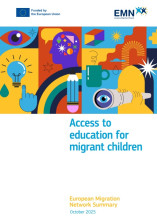
On 31 October 2025, the European Migration Network (EMN) released its latest Inform highlighting how 25 EMN Member and Observer Countries are addressing access to education for migrant children. The report shows that nearly all participating countries have adopted national measures to support linguistic, social, and emotional integration in schools. Despite persistent barriers, such as language difficulties and unequal learning outcomes, good practices are emerging across Europe, according to this Inform.
Theme:
Type:
Keywords:

29/09/2025
The Flemish government has decided that third-country workers – from outside the EU, Iceland, Liechtenstein, Norway and Switzerland – will follow a mandatory tailored integration trajectory from 2027. The initiative, proposed by Minister Hilde Crevits, will be delivered digitally and can be started in the country of origin or within six months of arrival in Flanders. The programme provides essential information on work, rights and responsibilities, and Flemish norms and values. Certain temporary or seasonal workers, students, and holiday-work participants are excluded.
Theme:
Type:
Keywords:
02/07/2025
In 2024, a total of 17.939 newcomers obtained an integration certificate in Flanders, according to the Jaarrapport Inburgering 2024. This is the highest number recorded since 2018 and marks a 16% increase compared to the previous year.
Theme:
Type:
Keywords:

27/06/2025
Nearly one in eight self-employed workers in Belgium do not hold Belgian nationality. This proportion rises to more than four in ten in the Brussels-Capital Region. An analysis of recent data from the National Institute for Social Security of the Self-Employed (INASTI) by the social insurance fund Acerta highlights these figures. The study also reveals differences in age, sector activity, and income between Belgian and non-Belgian self-employed individuals.
Theme:
Type:
Keywords:
06/06/2025
On 6 June 2025, the Flemish Government approved a communication advancing the development of pre-arrival integration trajectories for newcomers from their countries of origin. This step follows earlier pilot projects and aims to better prepare family reunification and labour migrants for life in Flanders through a digital societal orientation course.
08/05/2025
In 2024, 19.435 people participated in the Social Orientation (Maatschappelijke Oriëntatie, MO) course in Flanders. This marks a significant increase in participation. Alongside the rising numbers of participants in the Social Orientation course, the demand for Dutch as a Second Language (NT2) courses also remains high, as evidenced by recent reports from AMAL vzw, Atlas Antwerp, and the Agency for Integration and Civic Integration.
01/05/2025
On the occasion of Labour Day, Fedasil published new figures on the professional activity of applicants for international protection residing in reception centres. In 2024, 41% of those allowed to work were active on the Belgian labour market. The data show differences in employment rates depending on gender, age, and nationality.
Theme:
Type:
Keywords:
10/04/2025
The Education Department of Caritas International Belgium, in collaboration with the non-profit organisation Sankaa, has launched "Building Bridges", an educational resource for secondary school teachers. This resource helps educators address key topics such as identity, prejudice, racism, and media representation. At its core, "Building Bridges" explores the central question: How can we create a more supportive and inclusive society where everyone has a place?
Theme:
Type:
Keywords:

19/02/2025
About sixty Eritrean refugees gathered in front of the Town Hall in Ghent to draw the authorities' attention to the impact of the housing crisis on their situation and integration prospects. The authorities expressed their intention to find solutions but called on Minister of Asylum and Migration Anneleen Van Bossuyt to address this issue together. They also stated that they would consider a European response to this widespread problem.

04/02/2025
In a recent judgment, the Court of Justice of the European Union (CJEU) held that national legislation may oblige beneficiaries of international protection to pass a civic integration examination. However the fact of having failed such an examination cannot be systematically penalised by a fine.