This ad hoc query examines whether third-country nationals (TCNs) who are subject to national entry bans or are included in "Stop Lists" are removed from these lists upon marriage to an EU citizen. It further maps the specific procedures, required documentation, and assessment criteria used by EMN Member Countries to distinguish genuine relationships from marriages of convenience.
15/05/2026
This ad hoc query examines the ways in which EMN Member and Observer Countries calculate periods of absence in the context of applications for an EU Long-Term Residence Status, which requires 5 years of continuous residence. Additionally, this ad hoc query inquires about the use of Artificial Intelligence (AI) or Optical Character Recognition (OCR) in EMN Member and Observer Countries, or any future plans to do so.
Theme:
Publication type:
Keywords:
12/05/2026
This Inform examines how digital services in legal migration procedures are designed and implemented in EMN Member and Observer Countries to ensure accessibility and inclusion for applicants with disabilities and digitally disadvantaged applicants. It looks at how authorities have adapted applications, document submission, appointment booking, communication and information exchange, and case-tracking services in the context of the ongoing digitalisation of legal migration procedures. The analysis is based on contributions from 25 EMN Member and Observer Countries.
Theme:
Publication type:
Keywords:
10/04/2026
This ad hoc query examines the extent to which EMN Member and Observer Countries require medical certificates in the context of applications for temporary and permanent residence permits. More specifically, it inquires at what stage in the procedure the medical certificate is requested and what medical conditions are examined.
Theme:
Publication type:
Keywords:

02/04/2026
The Belgian Constitutional Court has clarified how the means of subsistence requirement applies in family reunification applications. The ruling establishes that the means of subsistence of both the Belgian sponsor and their partner must be taken into account when assessing compliance with this requirement. Previously, some applications were refused because only the sponsor’s means were considered. The decision aims to ensure compliance with principles of equality, non-discrimination, and respect for family life.
03/03/2026
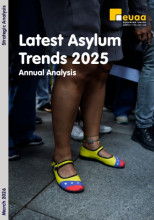
According to the Latest Asylum Trends 2025 published by the European Union Agency for Asylum (EUAA), EU+ countries received approximately 822.000 applications for international protection in 2025, representing a 19 % decrease compared to 2024. Despite the overall decline, demand for protection remained significant in some groups and countries.
03/03/2026
The Latest Asylum Trends 2025 provides an annual overview of asylum activity in EU+ countries, covering asylum applications (per capita), the main nationalities of applicants, the top receiving countries, recognition rates, pending cases and the number of beneficiaries of temporary protection following the war in Ukraine. It also reviews policy developments in the EU+ and provides a 2026 outlook, examining, inter alia, geopolitical uncertainty and latent displacement risks.
Theme:
Publication type:
Keywords:
27/02/2026
This ad hoc query shines light on the practices applicable in EMN Member Countries regarding applications for family reunification by third-country nationals and their family members who enjoy visa-free travel for short-stays in the EU, in the context of the implementation of the Family Reunification Directive (2003/86/EC).
Theme:
Publication type:
Keywords:

26/02/2026
The Belgian Constitutional Court has temporarily suspended legislative measures introduced in 2025 that tightened rules on material reception conditions for asylum seekers and family reunification for beneficiaries of subsidiary protection. The suspensions concern two separate laws, and the Court has referred several preliminary questions to the Court of Justice of the European Union (CJEU) to clarify their compatibility with EU law.
24/02/2026
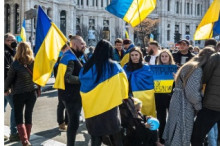
Four years after Russia launched its full-scale invasion of Ukraine on 24 February 2022, Belgium has granted more than 101.500 temporary protection certificates to people fleeing the conflict. Today, around 70.600 of these displaced Ukrainians remain in the country. While the temporary protection scheme has been extended until March 2027, uncertainty remains over what will happen afterwards, raising questions for both the authorities and Ukrainian beneficiaries.
19/02/2026
On 19 February 2026, EMN Belgium attended a Mutual Learning Seminar organised by ECRE (European Council on Refugees and Exiles) within the framework of the INNOVATE project, supported by EU funding under the Horizon 2020 programme.Held in Brussels, the seminar brought together experts, civil society representatives and policymakers to assess the state of preparedness across EU Member States for transitioning out of temporary protection under the Temporary Protection Directive, currently extended until March 2027.
Theme:
Type:
Keywords:

05/02/2026
Twenty-five organisations have submitted a petition to the Belgian Constitutional Court challenging the new family reunification law, which entered into force in August 2025. The petition highlights concerns that the law creates barriers that may prevent families from reuniting, potentially separating children from their parents indefinitely.
Theme:
Type:
Keywords:
19/01/2026
This ad hoc query examines whether EMN Member Countries are developing or considering initiatives to maintain and strengthen the connections between beneficiaries of temporary protection displaced from Ukraine and their country of origin. It aims to map projects that support continued engagement with Ukraine, including information provision to enable informed decisions about possible return. The query also explores whether such initiatives contribute to future recovery and sustainable reintegration.
Theme:
Publication type:
Keywords:
18/01/2026
This ad hoc query provides an overview of which EMN Member and Observer Countries require criminal record certificates in order to issue long-stay visas or residence permits. Details are provided on the categories of third-country nationals exempted from this requirement, the countries from which these certificates are required (country of origin and/or of previous residence), the other types of documents that may be accepted in lieu of a certificate (such as an affidavit), and more.
Theme:
Publication type:
Keywords:
02/01/2026
Fragomen will host a webinar on recent changes to Belgium’s immigration policies. The session will cover two main areas: first, new rules in the Flanders Region concerning economic migration, including labour migration pathways, contractual liability, and labour market testing; and second, nationwide modifications affecting family reunification, such as stricter financial criteria for visa applications. The webinar will also highlight practical implications for businesses employing foreign nationals.