Other government information and services: belgium.be

  • EN
  • NL
  • FR
EMN

Main navigation

  • Home
  • EMN Publications
    • Annual Reports
    • Thematic Studies
    • Informs
    • Ad Hoc Queries
    • EMNews
    • Glossary
  • All Publications
    • Reception
    • International Protection
    • Temporary Protection
    • Economic Migration
    • Family Migration
    • Student Migration
    • Citizenship & Nationality
    • Statelessness
    • Borders & Visa
    • Irregular Migration
    • Return & Readmission
    • Smuggling & Trafficking
    • Integration
    • Vulnerable Groups
    • External Dimension
  • News & Agenda
    • News
    • Agenda
    • EMN Belgium Policy Event 2026
  • About EMN
    • EMN Belgium
    • EMN Europe
    • EMN Activities
    • Contact Us
  • Clear all filters

Publication type

  • EMN Informs (1)
  • EMN Ad Hoc Queries (5)
  • External publications (2)

Year

  • (-) 2026 (4)
  • 2025 (5)
  • 2024 (1)
  • 2023 (1)
  • 2022 (3)
  • 2020 (1)
  • 2019 (1)
  • (-) 2017 (1)
  • 2014 (1)
  • 2013 (5)
  • 2012 (3)
  • (-) 2011 (3)

Ad Hoc Query on methodology for calculating periods of absence

15/05/2026

This ad hoc query examines the ways in which EMN Member and Observer Countries calculate periods of absence in the context of applications for an EU Long-Term Residence Status, which requires 5 years of continuous residence. Additionally, this ad hoc query inquires about the use of Artificial Intelligence (AI) or Optical Character Recognition (OCR) in EMN Member and Observer Countries, or any future plans to do so. 

Theme:
Economic migration
Family Migration
Student Migration
Publication type:
Ad Hoc Queries
Keywords:
long-term residence
continuous residence
period of absence
entry exit system
digitalisation

Bridging the digital divide: Digital services in legal migration procedures for accessibility and inclusion (EMN Inform)

12/05/2026

This Inform examines how digital services in legal migration procedures are designed and implemented in EMN Member and Observer Countries to ensure accessibility and inclusion for applicants with disabilities and digitally disadvantaged applicants. It looks at how authorities have adapted applications, document submission, appointment booking, communication and information exchange, and case-tracking services in the context of the ongoing digitalisation of legal migration procedures. The analysis is based on contributions from 25 EMN Member and Observer Countries.

Theme:
Economic migration
Family Migration
Student Migration
Citizenship & Nationality
Borders & Visa
Publication type:
Informs
Keywords:
legal migration
digitalisation
accessibility
inclusion

Ad Hoc Query on medical examination requirements in future amendments of national residence permit regulations

10/04/2026

This ad hoc query examines the extent to which EMN Member and Observer Countries require medical certificates in the context of applications for temporary and permanent residence permits. More specifically, it inquires at what stage in the procedure the medical certificate is requested and what medical conditions are examined.  

Theme:
Economic migration
Family Migration
Student Migration
Publication type:
Ad Hoc Queries
Keywords:
application for a residence permit
medical examination
medical certificate

Ad Hoc Query on criminal record certificates

18/01/2026

This ad hoc query provides an overview of which EMN Member and Observer Countries require criminal record certificates in order to issue long-stay visas or residence permits. Details are provided on the categories of third-country nationals exempted from this requirement, the countries from which these certificates are required (country of origin and/or of previous residence), the other types of documents that may be accepted in lieu of a certificate (such as an affidavit), and more.

Theme:
Economic migration
Family Migration
Student Migration
Borders & Visa
Publication type:
Ad Hoc Queries
Keywords:
visa
residence permit
application
criminal record certificate
security

Ad Hoc Query on transposition of directive 2016/801 (students, au pairs, …)

24/04/2017

23 (Member) States provided information on how they are currently dealing with some aspects of Directive 2016/801, in particular types of financial resources used by international students, the use of frozen/blocked accounts by international students, and approved/recognised organisations mediating au pairs. This ad-hoc query was launched by the Belgian Contact Point to the EMN.

Theme:
Economic migration
Student Migration
Publication type:
Ad Hoc Queries
Keywords:
student directive

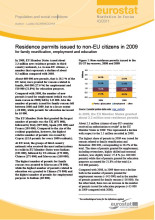
Eurostat Statistics in Focus: Residence permits issued to non-EU citizens

cover eurostat report statistics in focus

05/09/2011

In 2009, EU Member States issued about 2.3 million new residence permits to third country nationals, i.e. to non-EU citizens, a number that represents a decline of about
0.2 million compared with 2008.

Theme:
Economic migration
Family Migration
Student Migration
Data & Statistics
Publication type:
Report
Keywords:
Eurostat
residence permit

Ad Hoc Query on the employment of third-country students

25/05/2011

Ad hoc query, requested by the Swedish NCP concerning the possibilities for third-country students to remain in a European Union Member State after completing their studies in the EU. 20 responses

Theme:
Economic migration
Student Migration
Publication type:
Ad Hoc Queries
Keywords:
student migration

Policy on Student Migration to Belgium: History, State of Play, Projections

Cover page report

06/05/2011

Report of the Universities UG (Ghent) and ULB (Brussels) on behalf of the Belgian government

Theme:
Student Migration
Publication type:
Report
Keywords:
student migration
third-country nationals
  • Contact us | Links |  Youtube |  Twitter |  LinkedIn

  • Legal Notice & Privacy Policy

    Please carefully read the legal notice and privacy policy before using this website.

Co-funded by
the European Union

EU logo

Dynamate Dynamate
EMN Belgium

We value your privacy

We use cookies to make this website work and, with your consent, to measure its audience (Google Analytics). The site also uses Google reCAPTCHA to protect its forms against spam, and may embed YouTube videos.

For more information, see our privacy policy.

Strictly necessary cookies Always active

Required for the website to function: security, form protection (Google reCAPTCHA) and remembering your cookie choices. They cannot be disabled.

Audience measurement (Google Analytics)

Helps us understand how the site is used so we can improve it. No data is sent to Google until you give your consent.

Embedded videos (YouTube) may set Google cookies when they are played.