Trafficking in human beings is a crime against the victim’s fundamental rights. It can take several forms, such as sexual exploitation, forced labour or services, slavery and servitude-related practices, as well as the removal of organs. This practice is prohibited under numerous EU and international instruments. Yet, persistent demand for sexual services and for low-wage workers employed in manual jobs continues to provide opportunities for traffickers to exploit human beings.
06/05/2022
Theme:
Publication type:
Keywords:
28/04/2022
On 25 April 2022, the EMN published its inform on attracting and retaining international researchers, which provides an overview of the means adopted by Member States to enhance attractiveness for international researchers, as well as the main challenges and best practices that they encountered to admit and retain them.
Theme:
Publication type:
12/03/2022
The use of migration as a weapon of sorts by states and non-state actors for reaching their various goals has increased. The aim of the present study is to raise awareness among readers by creating a conceptual framework for the “weaponization of migration,” a phenomenon that has not been sufficiently studied academically yet.
Theme:
Publication type:
Keywords:
10/03/2022
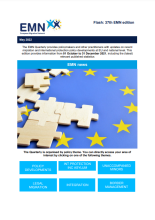
The 37th edition of the EMN Quarterly (previously named Bulletin) provides up-to-date information on recent migration and international protection policy developments at EU and national level.
08/03/2022
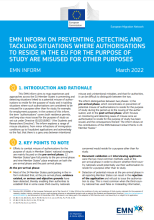
This EMN inform outlines approaches, experiences and best practices in monitoring, detecting and addressing the misuse of authorisations to reside in the EU for the purpose of study.
03/03/2022
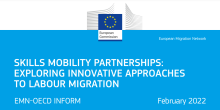
EMN in cooperation with the OECD published a new inform ‘Skills Mobility Partnerships: Exploring Innovative Approaches to Labour Migration’. This inform highlights experiences by EU Member States, non-EU countries and international organisations with regards to the introduction of Skills Mobility Partnerships (SMPs), a new concept that promotes a sustainable approach to skilled migration and mobility, with the aim to build skills for the benefit of both countries of origin and destination.
Theme:
Publication type:
Keywords:

10/02/2022
To what extent could digital services support migration and asylum management? This joint EMN-OECD inform focuses on specific areas in the asylum, migration and acquisition of citizenship procedures, and border control management, where digital technologies may be used.
Theme:
Type:
10/02/2022
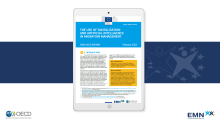
To what extent could digital services support migration and asylum management? This joint EMN-OECD inform focuses on specific areas in the asylum, migration and acquisition of citizenship procedures, and border control management, where digital technologies may be used.
Theme:
Publication type:

02/02/2022
How do Member States and Norway ensure the care and protection of children who arrive in their countries, and what measures are in place in relation to guardianship, education, access to justice, and more? This new report from the European Migration Network (EMN) provides an overview of the progress made during 2020 in the implementation of the recommendations laid out in the 2017 Communication on the protection of children in migration and is the second edition of a series of reports developed by the EMN.
Theme:
Publication type:
10/01/2022
This comparative report provides an overview of the use of digital tools and remote working methods in asylum processes in 23 European countries. It questions the risks and benefits of such use and highlights several fundamental guarantees and procedural safeguards which must continue to apply to ensure that they do not infringe the existing CEAS framework.