We are pleased to invite you to EMN Belgium’s National (hybrid) Conference “Skills Mobility Partnerships: The Belgian Case” on 14 December at 13.30pm (CET) at Residence Palace (Brussels).
PLEASE SAVE THE DATE.
Other government information and services: belgium.be
The 8th EMN Educational Seminar on Migration will be about “Migration in a Multilateral World” and will take place online from 24 till 26 August 2021. During three intensive days, the Seminar will focus on how migration and multilateralism is intertwined and how the international cooperation affects migrants and refugees in transiting or destination countries.
From 7 until 9 July 2021, the International Migration, Integration and Social Cohesion in Europe (IMISCOE), a European network of scholars in the area of migration and integration, will hold its annual conference. The event, entitled "Crossing borders, connecting cultures", will be held entirely online.
The Academy of European Law (ERA) organizes its annual conference on EU Border Management between 9 June 2021 and11 June 2021.
What is the EMN? How does it operate? Who is involved? And how can I engage with the EMN? The “Getting to know the EMN” open day on 2 June 2021 will offer participants the opportunity to find answer to these questions and more.
On the 9th of May, the European Union celebrates 'Europe Day'. This day commemorates the date of the Schuman Declaration, which was the starting point for today’s European Union.
On 15 December, EMN Belgium and the EMN Return Expert Group will host a half-day webinar on Alternatives to Detention. The online event focuses on the current legal framework on alternatives to detention, the implementation of these alternatives in practice and the identification of emerging good practices and pilot projects.
On October 21, the joint EMN-OECD inform on "Maintaining labour migration in essential sectors in times of pandemic" will be launched with a webinar.
This year's Austrian National EMN Conference will focus on migration forecasts, scenarios and early warning systems, in order to predict migration developments.
The outbreak of the COVID-19 pandemic and the substantial measures taken by EU and OECD countries to prevent the spread of the virus are having direct and indirect impacts on international students coming to those countries. While the long-term consequences are difficult to predict, the immediate impacts are already visible, for example, the processing of new applications or renewing of residence permits has in many cases been hindered or suspended, with consequences for international students already present in the host country. In addition, the abrupt downturn in economic activity has had a significant impact across many sectors, with international students facing the loss of their part time jobs or reduced or lost incomes, which could have an impact on their ability to continue their studies or find a job or start a business following their graduation.
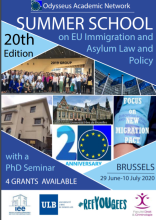
Each year, the Odysseus Network organizes a Summer School in EU immigration and asylum law and policy. The courses tackle the most recent legislative, jurisprudential and political developments in the field at EU level.
In its Review 2019, Fedasil presents the most important events and figures on reception, voluntary return and resettlement of the past year. The overview shows an increase in the number of people entitled to reception and for whom more than 5000 temporary places were opened in 2019.
On 25 June 2020, the European Asylum Support Office (EASO) will launch the 2020 edition of its annual flagship EASO Asylum Report. Due to the COVID-19 situation, this year EASO will be holding an online event to present and discuss the findings of the report, as well as developing asylum trends in the EU.
The event will serve to launch the 2019 edition of the EMN Annual Report on Migration and Asylum. It also seeks to provide the latest information on Member States responses to the COVID-19 pandemic.
The Academy of European Law organises its Annual Conference on European Immigration Law.The aim of the conference is to provide legal practitioners with an update on recent developments in the EU legal migration system and the mechanisms put in place to tackle labour and skills shortages and to reinforce the attractiveness of the EU for key workers.
The International Forum on Migration Statistics (IFMS) is a global platform devoted to improving data on migration in all its dimensions. Organised by IOM, OECD and UN DESA, the IFMS offers space for dialogue for a broad range of actors, from national and regional authorities, NGOs, international agencies and the private sector.